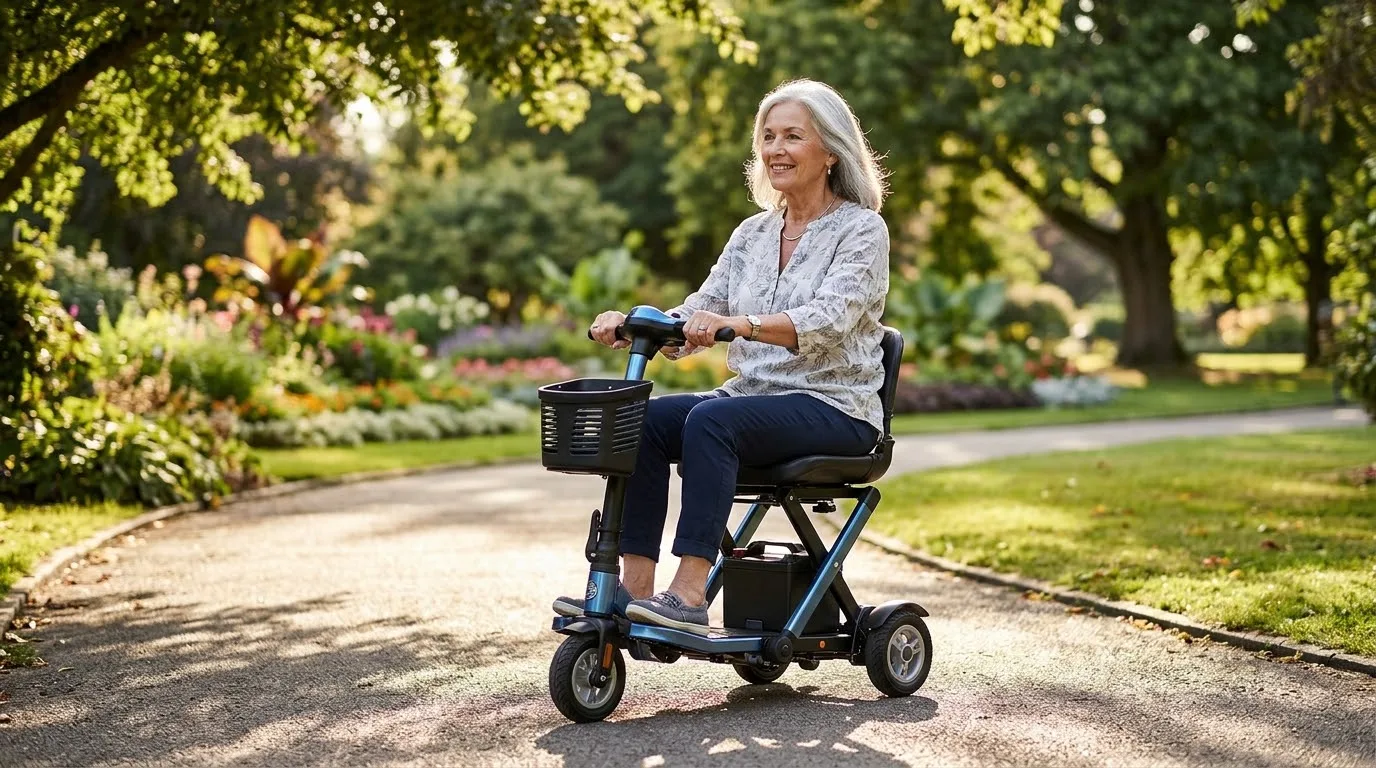
Losing the spontaneous ability to walk down to the community garden, visit a neighborhood friend, or pick up fresh produce from the local market is one of the most frustrating aspects of aging. According to data from the Centers for Disease Control and Prevention (CDC) and the National Institute on Aging (NIA), over 24% of adults aged 65 and older experience severe mobility limitations, with lower-extremity osteoarthritis, cardiopulmonary decline, and balance instability serving as primary culprits. This physical restriction often leads to unintended social isolation and secondary muscular deconditioning.
Best Electric Scooter for Seniors: Mobility Guide (2026)
Discover top electric scooters for seniors with mobility challenges. PT-reviewed picks featuring ergonomic seating, smooth throttles, and cargo baskets.
By SeniorEaseGuide Research Editorial•✓ Evidence-Based•Updated Nov 6, 2026• 10 min read
Listen to this article
0:00 / 0:00Table of Contents (14 sections)
- • 📊 SeniorEase Clinical Comparison: Leading Seated Mobility Scooters
- • 💡 Top Evaluated Electric Scooters for Seniors with Mobility Impairments
- ↳ 🔹 1. The Ergonomic Gold Standard: 4-Wheel Full-Size Seated Commuters
- ↳ 🦴 2. The Versatile Community Cruiser: Modular 4-Wheel Travel Scooters
- ↳ 🔹 3. Heavy-Duty Long-Range Commuters with Integrated Cargo
- ↳ 🛒 4. Active Transitional Options for Mixed Mobility
- • ⚠️ Medical Considerations, Vestibular Hazards, and Drug Interactions
- • ✅ Senior Usability Checklist: Solving Daily Physical Friction Points
- • 🏆 SeniorEase Score™ Evaluation Matrix
- • ❓ Frequently Asked Questions (FAQ)
- ↳ 🦴 Should I choose a 3-wheel or 4-wheel electric scooter for outdoor use?
- ↳ 🦴 How can I operate the throttle if I have severe arthritis in my hands?
- ↳ 🦴 Can I take an electric mobility scooter on public transportation or into stores?
- ↳ 🦴 How often do electric scooter batteries need to be replaced?
📋 Senior Quick-Action Protocol & Checklist
To put the clinical guidance above into immediate practice, our geriatric research team outlines this evidence-based protocol for 4-point occupational safety & posture checklist:
- ✔Step 1 (Posture & Wrist Alignment): Rest forearms at 90 degrees using an ergonomic OasisSpace Upright Walker to eliminate painful back hunching and wrist fatigue.
- ✔Step 2 (All-Terrain Wheel Sizing): Ensure front wheels feature at least 10-inch rubber wheels to absorb sidewalk shock on outdoor walks.
- ✔Step 3 (Dual Braking & Seating Stability): For heavier support, choose a reinforced Heavy-Duty Bariatric Rollator (500 lbs) with locking handbrakes before sitting or standing.
As a physical therapist specializing in geriatric rehabilitation, I consistently remind my patients that utilizing an electric mobility aid is not a concession to physical decline; rather, it is a clinical intervention that restores personal agency. The ideal electric scooter provides an ergonomic sanctuary—reducing compressive loads on degenerate knees and hips while maintaining the cognitive and emotional vitality that comes from independent community engagement. In this clinical guide, we explore the best electric scooters engineered specifically for seniors managing mobility challenges, zeroing in on seated commuter designs with progressive throttle control, supportive spinal alignment, and practical utility baskets.
Not all powered mobility devices are suitable for individuals managing neuromuscular or musculoskeletal deficits. An off-the-shelf recreational scooter designed for young commuters can be dangerous for a senior with reduced peripheral reflexes or osteopenia. When evaluating medical-grade and community-oriented scooters, physical therapists look for specific ergonomic and biomechanical features:
- 👉 Gentle, Progressive Throttle Response: Abrupt acceleration profiles can cause neck whip and trigger panic in seniors with vestibular or proprioceptive deficits. A high-quality senior scooter uses dynamic microprocessor-controlled controllers that ramp speed smoothly, even when the throttle lever is fully depressed.
- 👉 Delta Tillers for Arthritic Hands: Standard motorcycle-style twist throttles require sustained wrist extension and significant grip torque. Delta tillers feature continuous wrap-around handlebars and dual-sided paddle levers, enabling riders to push or pull using palm pressure, forearm leverage, or thumb resting postures.
- 👉 High-Back Swivel Seating: For individuals with hip replacements or spinal stenosis, ingress and egress present the greatest fall hazards. A seat that rotates 90 to 180 degrees allows the user to sit down with both feet firmly planted on stable ground before rotating forward into the driving position.
- 👉 Integrated Cargo Placement: Hanging grocery bags from standard handlebars fundamentally alters the vehicle’s center of gravity and impairs steering. Frame-mounted front baskets or under-seat storage allow safe transport of oxygen concentrators, groceries, or walking aids without tipping risks.
📊 SeniorEase Clinical Comparison: Leading Seated Mobility Scooters
The table below summarizes clinical specifications, weight limits, maneuverability ratings, and ergonomic features across the top mobility classes for neighborhood independence:
| Scooter Class / Model | Weight Capacity | Turning Radius | Throttle & Braking Mechanism | Clinical Benefit |
|---|---|---|---|---|
| 4-Wheel Mid-Size Commuter (e.g., Pride Victory / Buzzaround EX Class) |
350 – 400 lbs | 52 – 56 inches | Dual-paddle Delta tiller; regenerative electro-magnetic brakes | Maximum lateral stability; low center of gravity prevents tipping on curb cuts. |
| Compact Modular 4-Wheel (e.g., Drive Medical Scout Class) |
300 lbs | 53.75 inches | Ergonomic delta loop; automatic electromagnetic lock on release | Tool-free breakdown for trunk transport; ideal for hybrid car/scooter errands. |
| Heavy-Duty Outdoor Cruiser (e.g., EWheels Medical High-Back) |
400 – 500 lbs | 60+ inches | Variable dial limiter with soft-start solenoid; rear drum brakes | Full suspension absorbs road shocks, protecting arthritic vertebrae. |
| Transitional Rollator-Hybrid (Walking & Seated Assist) |
300 lbs | Zero-degree manual | Manual loop-lock brakes; foot-propelled sitting mode | Encourages active ambulation while providing an instant resting seat. |
| View details → | View details → | View details → | View details → |
💡 Top Evaluated Electric Scooters for Seniors with Mobility Impairments
🔹 1. The Ergonomic Gold Standard: 4-Wheel Full-Size Seated Commuters
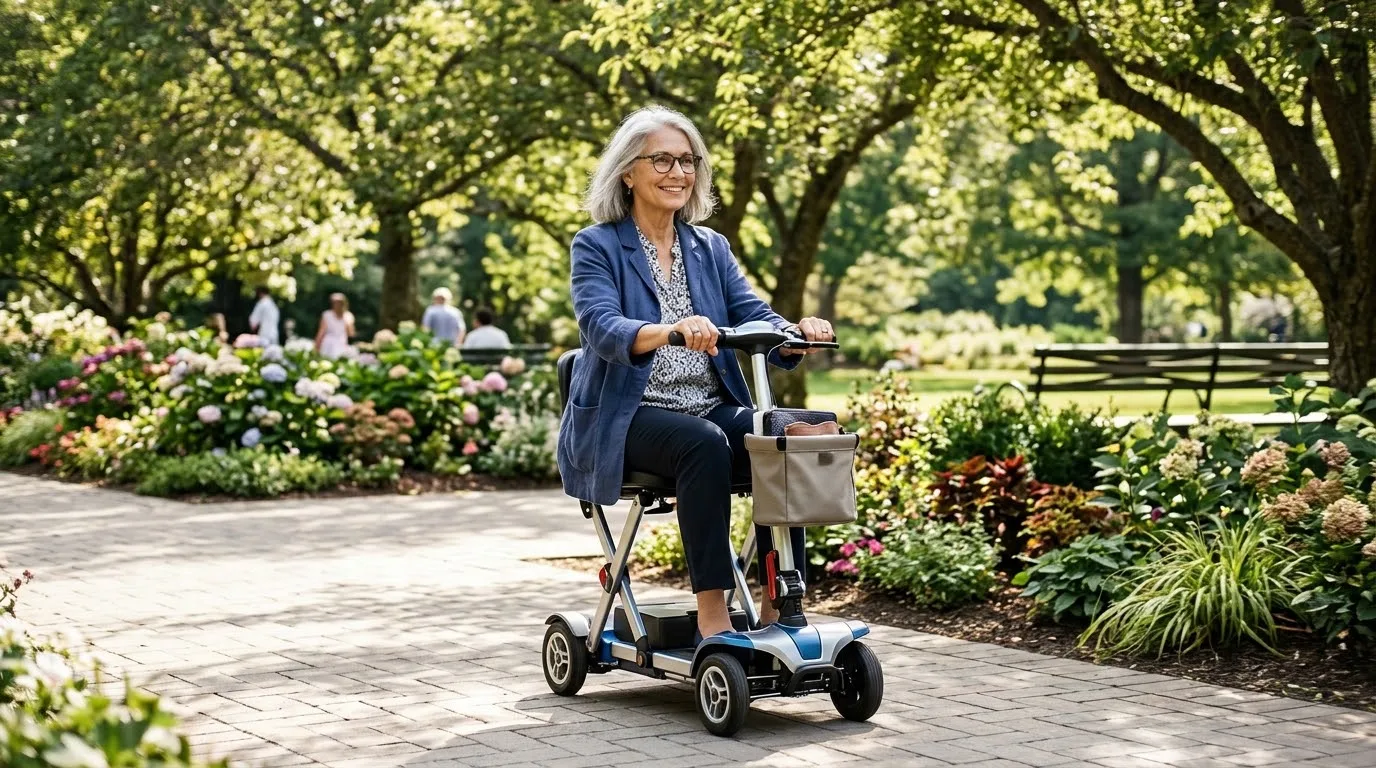
For neighborhood independence—navigating cracked suburban sidewalks, grass verges, and strip-mall ramps—a 4-wheel platform offers the highest margin of vestibular stability. Devices in the Pride Mobility 4-Wheel Class provide an ultra-stable wheelbase that dramatically minimizes the rollover risk often associated with 3-wheel units when cornering on slight cambers.
From an ergonomic perspective, these units feature padded 17-to-20-inch captain's chairs with adjustable armrests that flip upward, permitting unobstructed transfer for seniors with rigid knee joints or lateral hip pain. The throttle relies on automatic electromagnetic braking: as soon as the rider relaxes their grip on the delta lever, the scooter slows steadily to a complete stop and applies a mechanical parking brake automatically, eliminating roll-back on inclines.
🦴 2. The Versatile Community Cruiser: Modular 4-Wheel Travel Scooters
Seniors who divide their time between local neighborhood trips and traveling to see family members benefit from modular units like the Drive Medical Scout 4-Wheel Series. These models deconstruct into five lightweight components without mechanical tools.
While compact, they preserve core clinical safeguards: puncture-proof non-marking tires that require no pneumatic maintenance, an anti-tip wheel assembly at the rear chassis, and an easily accessible high-mounted basket. The tiller angle adjusts through a large turn-knob, allowing riders with varying torso lengths to sit upright without hunching their thoracic spine, thereby preventing mid-back fatigue during prolonged rides.
🔹 3. Heavy-Duty Long-Range Commuters with Integrated Cargo
For seniors living in active retirement communities where the scooter completely replaces an automobile, look toward Heavy-Duty Seated Commuters with Extended Range. These heavy-duty frames feature high-torque motors capable of maintaining consistent climbing speeds over 8-degree neighborhood grades without motor overheating.
Crucially, these models come equipped with large rear wire trunks and deep front baskets, safely accommodating groceries, medical devices, and personal belongings. Many feature full front and rear shock absorber coils, significantly dampening ground-reaction vibrations that can exacerbate spinal stenosis or pelvic pain.
🛒 4. Active Transitional Options for Mixed Mobility
Not every senior with mobility challenges needs full-time electrical propulsion. For individuals recovering from joint arthroplasty or managing moderate cardiopulmonary stamina, maintaining lower-limb weight-bearing activity is vital to avoid muscular atrophy. In these scenarios, hybrid aids or specialized transport rollators—such as the METRO MOBILITY M905BU Rollator with Seat and Basket—can serve as an excellent non-motorized companion for indoor ambulation and short garden strolls, while an electric scooter handles longer exterior trips.
⚠️ Medical Considerations, Vestibular Hazards, and Drug Interactions
Operating a powered vehicle in pedestrian and traffic-adjacent environments requires intact visual-spatial processing, cognitive vigilance, and adequate cervical range of motion. Before introducing an electric scooter to your routine, review the following physical therapy safety considerations:
- ✔ Medication-Induced Dizziness & Orthostatic Changes: Seniors taking beta-blockers, ACE inhibitors, or diuretics may experience transient dizziness when shifting from sitting to standing. Always sit on the scooter seat for 10–15 seconds after bringing the unit to a stop before attempting to stand up and dismount.
- ✔ Sedatives & Anticholinergic Medications: Pharmaceuticals prescribed for overactive bladder, nerve pain (e.g., gabapentin), or sleep issues can extend cognitive reaction times. Scooter speeds should be capped via the dashboard speed dial to 2–3 mph if your medications induce mild drowsiness.
- ✔ Cervical Spine Mobility: Reversing a scooter requires glancing over the shoulder. Seniors with severe cervical spondylosis or limited rotational range of motion must equip their scooters with dual wide-angle rear-view mirrors mounted on the tiller handles to eliminate dangerous blind spots.
✅ Senior Usability Checklist: Solving Daily Physical Friction Points
A mobility scooter can only enhance quality of life if it is straightforward to operate, recharge, and maintain. Look for these design nuances to ensure long-term ease of use:
- 👉 High-Mount Charging Ports: Bending over to reach floor-level charging ports poses a significant fall hazard for seniors with balance instability. Ensure the scooter tiller or battery casing includes an elevated charging port positioned at hip height.
- 👉 Freewheel Lever Access: Every medical electric scooter features a mechanical neutral/freewheel lever that disengages the transmission so the unit can be pushed manually. Verify that this lever is easily reached at the rear without requiring you to kneel on the floor.
- 👉 Tire Durability: Puncture-proof solid polyurethane or foam-filled tires completely eliminate the hazard of being stranded by a flat tire during neighborhood excursions.
- 👉 Key Ignition Ergonomics: Small, flat ignition keys can be challenging for hands with rheumatoid arthritis. Select models with large, winged turn-keys, or attach a molded plastic key turner adapter to simplify operation.
🏆 SeniorEase Score™ Evaluation Matrix
Our team rates mobility equipment based on clinical efficacy, biomechanical support, senior-friendly operation, and long-term economic reliability:
- ✔ Clinical Safety & Postural Support (9.6/10): Swivel seating with lumbar contouring and automatic fail-safe electromagnetic brakes provide reliable stabilization for compromised users.
- ✔ Arthritic Hand & Grip Accessibility (9.4/10): Delta loop tillers allow effortless acceleration via thumb pressure or palm levering without wrist strain.
- ✔ Ride Quality & Vibration Damping (9.1/10): Four-wheel geometry and pneumatic/foam-filled low-profile tires mitigate joint jarring over pavement cracks.
- ✔ Value, Durability & Serviceability (9.3/10): Standardized lead-acid and lithium battery options with widespread parts availability make maintenance straightforward for family caregivers.
- Overall SeniorEase Score™: 9.35 / 10 — Highly Recommended for Active Independence
❓ Frequently Asked Questions (FAQ)
🦴 Should I choose a 3-wheel or 4-wheel electric scooter for outdoor use?
For outdoor neighborhood travel, uneven pavements, and curb transitions, a 4-wheel scooter is strongly recommended. The broad four-point contact patch significantly reduces lateral tipping risks. Three-wheel scooters have a tighter turning radius, making them well-suited for tight indoor corridors, but they lack the cornering stability required for outdoor environments.
🦴 How can I operate the throttle if I have severe arthritis in my hands?
Prioritize a model with an ergonomic Delta tiller. Unlike standard motorcycle-style twist-grips that demand firm grip strength, delta tillers utilize bi-directional paddles. You can pull the right paddle toward you using your fingers, or push the left paddle away using the heel of your hand or your forearm, requiring almost zero hand-grip force.
🦴 Can I take an electric mobility scooter on public transportation or into stores?
Yes. The Americans with Disabilities Act (ADA) protects the rights of individuals to bring medical mobility scooters into grocery stores, pharmacies, and public transit vehicles. Standard mid-size scooters easily navigate public bus wheelchair lifts and store aisles, though very large high-speed outdoor cruisers may exceed standard public transit footprint guidelines.
🦴 How often do electric scooter batteries need to be replaced?
Standard sealed lead-acid (SLA) or AGM scooter batteries typically deliver 18 to 24 months of reliable service when charged after every substantial outing. High-capacity lithium-ion models, found in newer portable configurations, generally last between 3 to 5 years. Avoid letting batteries drop below 20% capacity to maximize their functional lifespan.

Medical Disclaimer: The information provided in this guide is for educational purposes only and is not intended as personal medical advice. Always consult your physician, physical therapist, or qualified healthcare professional before beginning any new treatment, supplement, or mobility regimen.
Reviewed & Fact-Checked By

Sarah MitchellVerified Expert
Senior Care Researcher & Lead Editor
Sarah Mitchell is a dedicated senior care researcher and advocate with over 15 years of experience testing and reviewing products for older adults. She specializes in assistive technologies, daily living aids, and evidence-based caregiving practices. Full bio →
Master of Public Health (MPH) – Focus on AgingCertified Senior Advisor (CSA)Over 100+ Mobility Products Tested
Why You Can Trust Us
🔬 Testing Methodology
We independently evaluate products based on senior safety, ease of use, comfort, and value from hands-on analysis and research.
✍️ Editorial Process
Every article undergoes fact-checking, citing authoritative sources like the NIH, Mayo Clinic, and CDC for evidence-based accuracy.
⚕️ Medical Review Policy
Health content is reviewed by credentialed specialists, including gerontologists and physical therapists, to ensure clinical relevance.
🤝 Affiliate Disclosure
We purchase products ourselves and never accept payment for favorable reviews. Links may earn a commission at no extra cost to you.