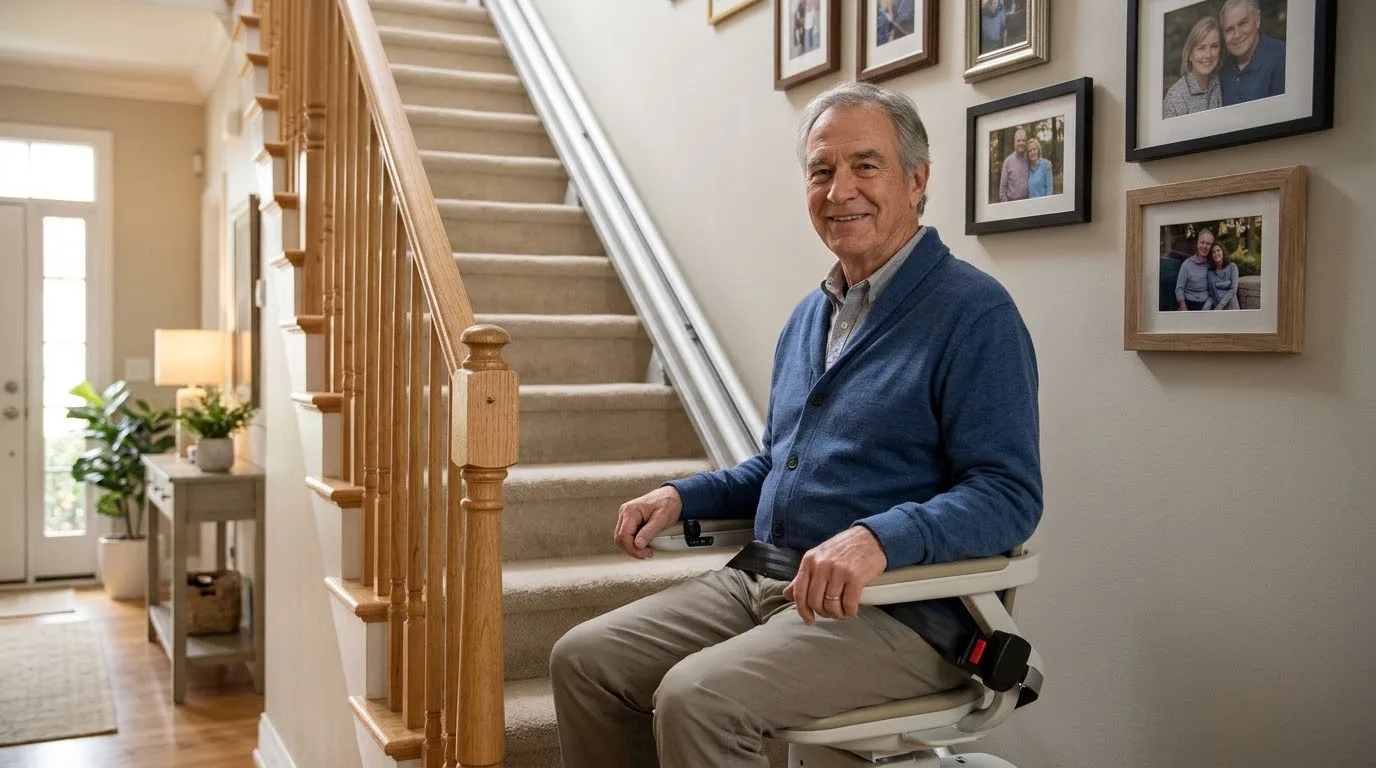
For many older adults, the staircase represents an invisible boundary inside their own home. What was once an effortless transition between living spaces gradually turns into an obstacle course fraught with joint pain, shortness of breath, and apprehension. According to data from the Centers for Disease Control and Prevention (CDC), one in four Americans aged 65 and older falls each year, and stairways remain one of the most perilous locations for catastrophic injury, including hip fractures and subdural hematomas.
Acorn 130 Stair Lift Review: Senior Safety Test (2026)
Read our physical therapist review of the Acorn 130 Stair Lift. Discover specs, swivel seat safety, battery backup reliability, and installation costs.
By SeniorEaseGuide Research Editorial•✓ Evidence-Based•Updated Nov 11, 2026• 10 min read
Listen to this article
0:00 / 0:00Table of Contents (17 sections)
- • ⚙️ Acorn 130 Technical Specifications & Engineering Overview
- • 🛡️ Key Safety Systems: An In-Depth Medical Evaluation
- ↳ 🔹 1. The Mechanical Swivel Seat and Safe Disembarkation
- ↳ 🔹 2. Constant-Charge DC Battery System
- ↳ 🔹 3. Ergonomic Paddle Switches for Arthritic Hands
- • 🛒 Comparative Analysis: How the Acorn 130 Stacks Up
- • 🚶 Integrating Stair Lifts with Secondary Mobility Aids
- • 💰 Installation, Rail Requirements, and Real-World Costs
- ↳ 🛒 Cost Breakdown:
- • ⚠️ Medical Considerations & Precautions
- • ⭐ SeniorEase Score™: Acorn 130 Evaluation
- • ❓ Frequently Asked Questions
- ↳ 🔹 Can the Acorn 130 be installed on a curved staircase?
- ↳ 🔹 What happens if an obstacle is left on the stairs during transit?
- ↳ 🔹 How much space does the stair lift leave for other family members?
- ↳ 🔹 How long do the internal backup batteries last before needing replacement?
- • 💡 The Final Verdict
📋 Senior Quick-Action Protocol & Checklist
To put the clinical guidance above into immediate practice, our geriatric research team outlines this evidence-based protocol for restorative sleep & cervical alignment protocol:
- ✔Step 1 (Cervical Spine Leveling): Align your neck horizontally using an Adjustable Loft Ergonomic Pillow or orthopedic Cervical Memory Foam Pillow to eliminate morning neck stiffness.
- ✔Step 2 (Bedroom Thermal Window): Keep ambient temperature at 65°F–68°F paired with breathable Cooling Bamboo Sheets to facilitate deep restorative delta sleep.
- ✔Step 3 (Restorative Mineral Wind-Down): Consider gentle sleep relaxation with Magnesium Glycinate 400mg 45 minutes before bedtime to prevent midnight muscle tension.
As a physical therapist, I regularly treat patients whose loss of independence accelerated rapidly after a single misstep on a stairway. When multi-story living becomes unsafe, families often consider assisted living facilities or expensive ground-floor renovations. However, mechanical stair lifts offer a practical middle ground. The Acorn 130 Straight Stairlift is arguably the most widely installed straight-rail motorized lift in North America. In this comprehensive clinical and functional review, we evaluate the Acorn 130 through the lens of senior biomechanics, arthritic usability, engineering reliability, and overall fall-prevention value.
Navigating stairs is one of the most complex motor activities the human body routinely performs. It demands synchronized neuromuscular control, adequate quadriceps force, hip abductor stability, and intact proprioceptive feedback from the feet and ankles:
- 👉 Stair Ascent: Demands significant concentric contraction of the quadriceps and gluteal muscles, placing vertical ground reaction forces of up to three times body weight across the patellofemoral joint. For seniors with severe knee osteoarthritis or spinal stenosis, this produces acute pain and rapid fatigue.
- 👉 Stair Descent: Biomechanically, descent is far more hazardous. It relies on eccentric muscle control—lengthening the quadriceps under tension to control the downward drop. A sudden drop in eccentric strength, a bout of orthostatic hypotension, or depth-perception changes caused by bifocals or cataracts can result in an uncontrolled tumble.
The Acorn 130 removes these physiological bottlenecks entirely. By transitioning the senior from an unstable dynamic ascent into a seated, mechanically stabilized position, the cardiovascular and musculoskeletal strain of stair navigation is neutralized.
⚙️ Acorn 130 Technical Specifications & Engineering Overview
The Acorn 130 is engineered specifically for standard, straight staircases without landings, curves, or intermediate turns. Built upon a legacy of UK design and assembled across global hubs, its current iteration features a maintenance-free rack-and-pinion drive system mounted to an extruded aluminum rail.
| Specification | Acorn 130 Parameter | Clinical & Practical Significance |
|---|---|---|
| Weight Capacity | 300 lbs (Standard) / 350 lbs (HD Option) | Accommodates the vast majority of users; ensures motor longevity. |
| Drive Mechanism | Steel Rack and Pinion | Provides non-slip mechanical traction with minimal lurching. |
| Power Supply | Direct Current (24V DC Twin Batteries) | Continuous function during residential blackouts and power surges. |
| Track System | Extruded Aluminum Rail | Fastens directly to stair treads, leaving walls untouched. |
| Seat Dimensions | Width: ~17.5" | Depth: ~16" | Padded, flame-retardant wipe-clean vinyl for easy hygiene. |
| Swivel Action | Manual lever (Powered option available) | Rotates user 90 degrees onto the top landing away from the staircase drop. |
| Safety Sensors | Five perimeter safety edges | Instant auto-stop upon contacting pets, clothing, or misplaced objects. |
| View details → | View details → |
🛡️ Key Safety Systems: An In-Depth Medical Evaluation
🔹 1. The Mechanical Swivel Seat and Safe Disembarkation
The most dangerous moment of using any stair lift is not the ride itself—it is the transfer into and out of the chair at the top landing. If a user tries to stand up while facing out over the open staircase, a momentary loss of balance will send them tumbling backward down the flight.
The Acorn 130 addresses this via its manual swivel system, operated by dual levers located on either side of the seat base. At the top of the stairs, pressing down on the lever allows the entire seat carriage to pivot 90 degrees, locking firmly into place facing directly onto the upper floor hallway. The footrest and armrests now serve as a secure staging platform. For seniors with severe spinal rigidity, Parkinsonian freezing, or stroke-induced hemiplegia, opting for the powered swivel upgrade is strongly recommended, as it eliminates the upper-extremity torque needed to rotate manual levers.
🔹 2. Constant-Charge DC Battery System
Older generation stair lifts drew AC power directly through a trailing mains umbilical cable, which was prone to snagging and left users stranded mid-flight during severe weather. The Acorn 130 runs on twin 12-volt rechargeable batteries (a 24V DC system) housed inside the carriage chassis. As long as the lift rests near its charging points at the top or bottom of the rail, the batteries remain trickle-charged.
From an emergency preparedness standpoint, this provides tremendous peace of mind. During winter storms or summer grid failures, the lift can still complete up to 10 to 15 full trips, preventing an elderly individual from becoming isolated on an upper floor without access to medication, hydration, or telecommunications.
🔹 3. Ergonomic Paddle Switches for Arthritic Hands
Fine motor decline, carpal tunnel syndrome, and rheumatoid arthritis often make grasping small joystick knobs or depressing stiff buttons painful. The Acorn 130 uses a soft-touch rocker paddle switch located at the end of the armrest. Operating the lift requires only gentle lateral pressure using the palm, wrist, or side of the hand in the direction of travel. When pressure is released, the carriage smoothly decelerates to a complete stop.
🛒 Comparative Analysis: How the Acorn 130 Stacks Up
To evaluate its position in the home accessibility market, we compared the Acorn 130 to leading straight stair lift models, including the Bruno Elan and Harmar Pinnacle SL300.
| Model | Weight Limit | Drive Type | Charging Architecture | Warranty Highlights |
|---|---|---|---|---|
| Acorn 130 | 300 - 350 lbs | Rack & Pinion | Top & Bottom Terminal Charge | 1-Yr Comprehensive (Extended available) |
| Bruno Elan SRE-3050 | 300 lbs | Rack & Pinion | Continuous Rail Charging | Limited Lifetime (Major components) |
| Harmar SL300 Pinnacle | 300 lbs | Nylon Poly Worm Gear | Continuous Rail Charging | 2-Yr Parts / 10-Yr Gear |
| View details → | View details → | View details → | View details → |
While the Bruno Elan boasts a more generous domestic warranty and the Harmar Pinnacle utilizes a lubrication-free worm gear, Acorn dominates in rapid fulfillment and global direct-to-consumer infrastructure. Acorn’s technician network typically allows for faster on-site evaluation and installation than regional dealer-dependent brands.
🚶 Integrating Stair Lifts with Secondary Mobility Aids
Installing a stair lift solves the vertical transit dilemma, but horizontal ambulation remains vital. Seniors should avoid relying on the stair lift as an excuse for general immobility. In clinical practice, we advise maintaining a secondary mobility device on each level of the home.
For example, a senior may navigate the first floor with a stable rollator, transfer directly into the Acorn 130, glide smoothly to the second floor, swivel securely onto the landing, and immediately transition to an awaiting wheeled device. Sturdy four-wheel models such as the METRO MOBILITY M905BU 4-Wheel Rollator Walker with Seat provide immediate post-transfer stability. For additional safety accessories and landing grab supports, explore verified stair lift accessories and safety rails to ensure zero unassisted steps during the transfer sequence.
💰 Installation, Rail Requirements, and Real-World Costs
Prospective buyers frequently ask whether installing a stair lift will damage their drywall or compromise architectural integrity. Stair lifts do not anchor to walls. The Acorn 130 rests on slender vertical stanchions screwed directly into the wooden or concrete staircase treads. Wall surfaces remain entirely untouched, and standard installations can be completed in roughly 2 to 4 hours by a certified technician.
🛒 Cost Breakdown:
- ✔ New System Installed: Generally ranges between $2,800 and $4,500, depending on staircase length, custom rail cuts, and optional power-swivel or folding-footrest add-ons.
- ✔ Certified Factory Reconditioned: Acorn frequently offers refurbished 130 units starting around $2,200 to $2,800, backed by manufacturer inspection.
- ✔ Insurance & Medicare Coverage: Traditional Medicare Part B classifies stair lifts as home modifications rather than Durable Medical Equipment (DME), meaning they are rarely covered. However, long-term care insurance policies, VA benefits (via HISA or SHA grants), and state-specific Medicaid Home and Community-Based Services (HCBS) waivers often provide substantial subsidies.
⚠️ Medical Considerations & Precautions
While the Acorn 130 is an outstanding fall-mitigation device, physical therapists and medical professionals emphasize several clinical precautions:
- 👉 Cognitive Awareness: Users must possess the cognitive capacity to hold down the control paddle until the carriage arrives at the charging point. Individuals with advanced vascular dementia or severe Alzheimer's should not operate the lift unassisted; caregivers should utilize the included wireless remote controls instead.
- 👉 Seatbelt Compliance: The retractable inertia reel seatbelt is not optional. Sudden stops triggered by obstruction sensors can pitch an unrestrained rider forward. Buckling up must be habitual.
- 👉 Narrow Staircase Clearance: The Acorn 130 folds up to a slim profile (~12.5 inches from the wall), but users with stiff, extended knees must ensure their feet do not collide with opposite balusters or handrails during transit.
⭐ SeniorEase Score™: Acorn 130 Evaluation
Our multidisciplinary assessment framework rates senior mobility devices across four foundational clinical metrics:
- ✔ Clinical Fall Reduction: 9.6 / 10 — Completely eliminates the physical vulnerability of staircase negotiation, neutralizing eccentric knee load and vertigo hazards.
- ✔ Ease of Use & Dexterity: 9.2 / 10 — The ergonomic palm paddle requires minimal hand grip strength, well-suited for advanced arthritic hands.
- ✔ Safety Engineering: 9.4 / 10 — Sensitive multidirectional safety edges and reliable terminal-dock DC batteries ensure safe, uncompromised transit.
- ✔ Value for Money: 8.8 / 10 — Competitive pricing for straight staircases, though after-warranty service contracts can be expensive.
- OVERALL SENIOREASE SCORE: 9.25 / 10
❓ Frequently Asked Questions
🔹 Can the Acorn 130 be installed on a curved staircase?
No. The Acorn 130 is engineered exclusively for single, unbroken straight flights of stairs. If your staircase includes an intermediate landing, a 90-degree turn, or a fan-shaped pie step, you will require a custom curved stair lift, such as the Acorn 180, which utilizes a specialized modular curved rail.
🔹 What happens if an obstacle is left on the stairs during transit?
The Acorn 130 is equipped with five sensitive cut-off safety switches distributed around the footrest edges and carriage chassis. If the lift encounters a misplaced item, a pet, or an errant shoe, the sensors trigger immediately, bringing the lift to a soft halt without tipping the rider. The carriage can still be operated in the reverse direction to back away from the obstruction safely.
🔹 How much space does the stair lift leave for other family members?
When not in use, the Acorn 130’s arms, seat, and footrest fold up flat against the rail, reducing its total projection into the stairway to approximately 12.5 to 13 inches. This ensures that ambulatory family members and guests can walk up and down the staircase freely without obstruction.
🔹 How long do the internal backup batteries last before needing replacement?
Under normal operational conditions with proper continuous charging at the docking terminals, the two sealed 12V lead-acid batteries typically last between 3 to 5 years. Replacement batteries are widely available and can be serviced easily by a certified technician or knowledgeable family member.
💡 The Final Verdict
The Acorn 130 Straight Stairlift remains a gold standard in modern aging-in-place engineering. For older adults struggling with progressive joint degradation, cardiovascular fatigue, or post-stroke gait instability, it offers a proven mechanical solution that safeguards physical autonomy. When combined with safe disembarkation protocols and regular mobility maintenance on each floor, the Acorn 130 transforms multi-level homes from dangerous fall hazards into comfortable, lifelong sanctuaries.


Medical Disclaimer: The information provided in this guide is for educational purposes only and is not intended as personal medical advice. Always consult your physician, physical therapist, or qualified healthcare professional before beginning any new treatment, supplement, or mobility regimen.
Reviewed & Fact-Checked By

Sarah MitchellVerified Expert
Senior Care Researcher & Lead Editor
Sarah Mitchell is a dedicated senior care researcher and advocate with over 15 years of experience testing and reviewing products for older adults. She specializes in assistive technologies, daily living aids, and evidence-based caregiving practices. Full bio →
Master of Public Health (MPH) – Focus on AgingCertified Senior Advisor (CSA)Over 100+ Mobility Products Tested
Why You Can Trust Us
🔬 Testing Methodology
We independently evaluate products based on senior safety, ease of use, comfort, and value from hands-on analysis and research.
✍️ Editorial Process
Every article undergoes fact-checking, citing authoritative sources like the NIH, Mayo Clinic, and CDC for evidence-based accuracy.
⚕️ Medical Review Policy
Health content is reviewed by credentialed specialists, including gerontologists and physical therapists, to ensure clinical relevance.
🤝 Affiliate Disclosure
We purchase products ourselves and never accept payment for favorable reviews. Links may earn a commission at no extra cost to you.