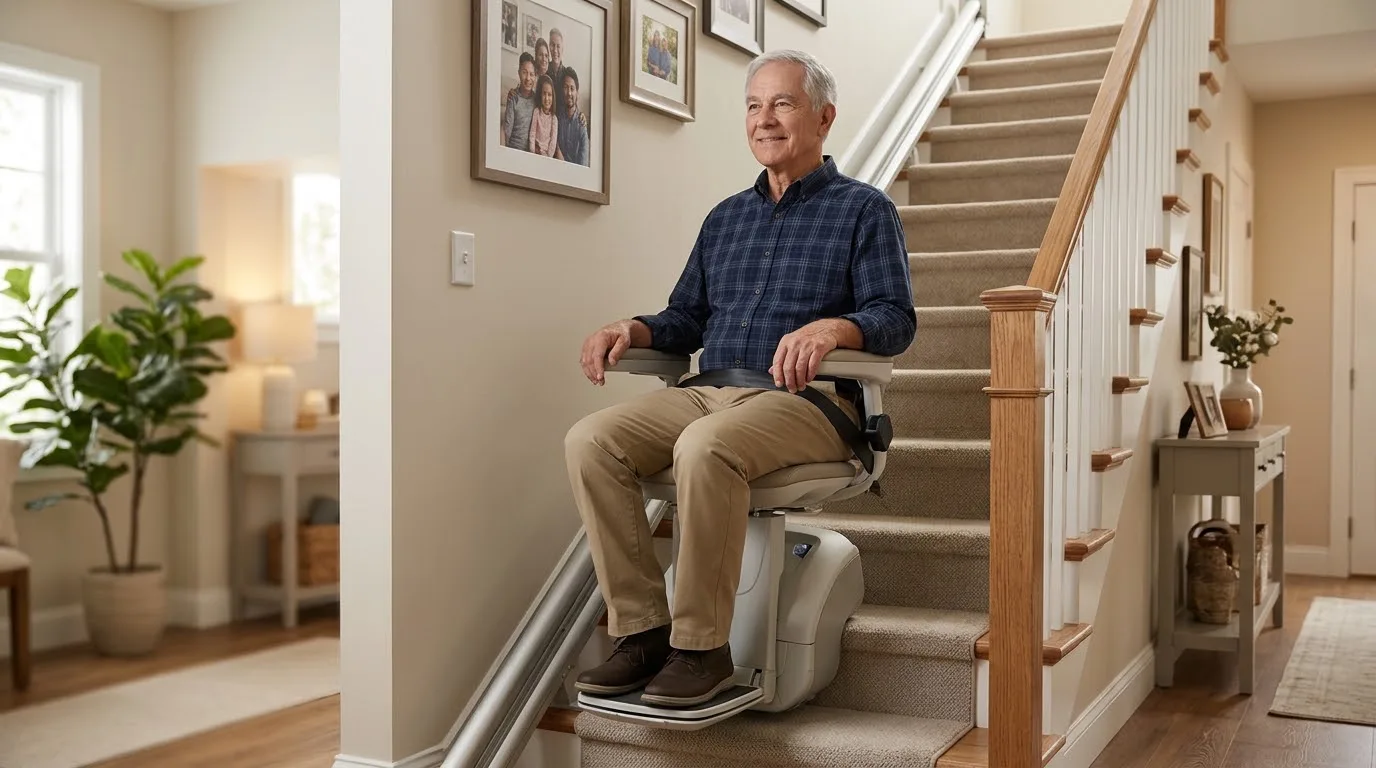
Staircases are frequently the single greatest architectural barrier to independent living. According to data from the Centers for Disease Control and Prevention (CDC), more than one out of four older adults falls each year, and stair-related falls carry an exceptionally high risk for debilitating hip fractures, subdural hematomas, and prolonged hospitalization. As a physical therapist working with geriatric rehabilitation, I often witness the painful tipping point where ascending 14 wooden steps transitions from a minor cardiovascular challenge into a daily hazard that threatens a senior’s ability to remain in their home.
AmeriGlide Stair Lift Review: An MSPT Evaluation (2026)
Our physical therapist reviews AmeriGlide stair lifts, covering DIY installation, weight ratings, safety features, and aging-in-place financial ROI.
By SeniorEaseGuide Research Editorial•✓ Evidence-Based•Updated Nov 16, 2026• 11 min read
Listen to this article
0:00 / 0:00Table of Contents (17 sections)
- • 🔍 AmeriGlide Stair Lift Overview: The Direct-to-Consumer Model
- • 📊 Comparative Specifications: AmeriGlide Flagship Models
- • 🛡️ Safety Systems, Biomechanics, and Fall Prevention
- ↳ 👉 Obstruction and Edge Sensors
- ↳ 👉 Swivel Seat Biomechanics for Safe Transfers
- ↳ 👉 Constant-Pressure Rocker Controls
- ↳ 👉 DC Battery Backup System
- • 🛠️ The DIY Installation Debate: Feasible or Dangerous?
- • 🖐️ Senior Usability: Arthritic Hands and Sensory Decline
- • 💰 Aging-in-Place ROI: Stair Lift vs. Assisted Living Costs
- • 📋 SeniorEase Score™: AmeriGlide Stair Lift Evaluation
- • ❓ Frequently Asked Questions (FAQ)
- ↳ 🔹 Will an AmeriGlide stair lift damage my home’s walls?
- ↳ 🔹 What happens if the electrical power goes out in my neighborhood?
- ↳ 🔹 Can an AmeriGlide stair lift be installed on a curved or split staircase?
- ↳ 🔹 Is a stair lift covered by traditional Medicare?
- • 💡 The Clinical Verdict
📋 Senior Quick-Action Protocol & Checklist
To put the clinical guidance above into immediate practice, our geriatric research team outlines this evidence-based protocol for restorative sleep & cervical alignment protocol:
- ✔Step 1 (Cervical Spine Leveling): Align your neck horizontally using an Adjustable Loft Ergonomic Pillow or orthopedic Cervical Memory Foam Pillow to eliminate morning neck stiffness.
- ✔Step 2 (Bedroom Thermal Window): Keep ambient temperature at 65°F–68°F paired with breathable Cooling Bamboo Sheets to facilitate deep restorative delta sleep.
- ✔Step 3 (Restorative Mineral Wind-Down): Consider gentle sleep relaxation with Magnesium Glycinate 400mg 45 minutes before bedtime to prevent midnight muscle tension.
For decades, installing a mechanical stair lift meant enduring aggressive high-pressure in-home sales pitches, lengthy lead times, and prohibitive price tags exceeding $5,000 to $10,000 for standard straight staircases. AmeriGlide stair lifts disrupted this traditional distribution model by pioneering a direct-to-consumer, DIY-friendly approach. In this comprehensive clinical and mechanical evaluation, we examine the mechanical integrity, safety sensors, track customizability, arthritic usability, and financial return on investment (ROI) of AmeriGlide’s core stair lift models to help you determine if they represent a clinically sound choice for your home.
From a biomechanical standpoint, negotiating stairs requires complex neuromuscular coordination, eccentric quadriceps control, intact proprioception, and substantial joint excursion. Ascending a standard 7-inch riser places compressive loads across the patellofemoral joint equivalent to three to four times body weight. For seniors suffering from tri-compartmental knee osteoarthritis, spinal stenosis, or post-stroke hemiparesis, this physical burden often leads to compensatory movement patterns, such as side-stepping or pulling excessively on handrails, which dramatically increases fall risk.
Furthermore, conditions such as orthostatic hypotension or transient ischemic attacks can cause sudden lightheadedness midway up a staircase. In clinical practice, the goal of an assistive device is not merely to accommodate weakness, but to conserve physical energy for safer participation in daily functional tasks. A stair lift preserves lower extremity stamina for safe transfers in the bedroom and bathroom. When combined with supportive ground-level mobility tools—such as a high-stability METRO MOBILITY M905BU 4-Wheel Rollator positioned on each floor—a reliable stair lift creates a comprehensive barrier-free living environment.
🔍 AmeriGlide Stair Lift Overview: The Direct-to-Consumer Model
AmeriGlide operates primarily out of Raleigh, North Carolina, distinguishing itself through an e-commerce, factory-direct sales strategy. Rather than requiring mandatory corporate installation packages, AmeriGlide allows homeowners or their designated handymen to purchase units directly and perform the installation themselves, potentially saving between $1,000 and $2,500 in installation labor fees alone. While they do offer nationwide third-party professional installation services for those who want peace of mind, their products are uniquely engineered with straightforward assembly in mind.
Their product portfolio spans straight stair lifts, curved custom units, outdoor weather-resistant lifts, and heavy-duty bariatric models. For the vast majority of residential homes with a single, uninterrupted flight of stairs, their flagship straight models—the AmeriGlide Rave 2, the AmeriGlide Horizon, and the heavy-duty AmeriGlide Rubicon—represent the core of their offerings.
📊 Comparative Specifications: AmeriGlide Flagship Models
The following table outlines the mechanical specifications, clinical capabilities, and engineering parameters of AmeriGlide’s leading straight stair lift systems:
| Model | Weight Capacity | Drive System | Folded Profile | Primary Clinical Focus |
|---|---|---|---|---|
| AmeriGlide Rave 2 | 350 lbs | Rack & Pinion (Polymer) | 11.5 inches | Ultra-compact; narrow staircases; grease-free rail |
| AmeriGlide Horizon Standard | 300 lbs | Rack & Pinion (Steel) | 13.75 inches | Ergonomic armrest controls; budget-friendly straight stairs |
| AmeriGlide Rubicon | 600 lbs | Dual Steel Cable / Direct Drive | 17.5 inches | Bariatric support; reinforced frame; extra-wide seat pan |
| Traditional Dealer Lifts (e.g., Bruno, Stannah) | 300–400 lbs | Rack & Pinion | 13–16 inches | Full-service white-glove setup; local dealer network service |
| View details → | View details → | View details → | View details → |
🛡️ Safety Systems, Biomechanics, and Fall Prevention
When prescribing assistive technology, a physical therapist scrutinizes how a machine mitigates human error. AmeriGlide integrates several crucial mechanical safety features designed to prevent falls during every phase of transit:
👉 Obstruction and Edge Sensors
Both the footrest and the main carriage chassis are lined with high-sensitivity perimeter safety switches. If a pet, discarded laundry, or a stray shoe is encountered on the track, the lift automatically halts transit within milliseconds without lurching forward. This prevents jarring deceleration forces that could destabilize a passenger with poor trunk control or cervical spine vulnerability.
👉 Swivel Seat Biomechanics for Safe Transfers
The vast majority of stair lift accidents occur not while moving, but during the transition of sitting down or standing up at the top landing. Stepping backwards onto an open stair tread is a recipe for catastrophe. AmeriGlide incorporates a 90-degree manual swivel seat mechanism with a positive locking detent. At the top of the stairs, the senior uses an ergonomic lever to swivel the entire seat toward the landing floor. This allows the user to place both feet firmly on solid, level flooring and push off the armrests symmetrically, effectively eliminating the risk of tumbling backward down the stairway.
👉 Constant-Pressure Rocker Controls
Cognitive load and panic responses are critical design considerations. AmeriGlide utilizes constant-pressure soft-touch paddle controls or joysticks located directly on the armrest. If an arthritic senior experiences a muscle spasm, sudden dizziness, or inadvertently releases the switch, the lift comes to an immediate, smooth stop. The controls require minimal pinching force, accommodating hands deformed by rheumatoid arthritis or peripheral neuropathy.
👉 DC Battery Backup System
AmeriGlide units operate on a continuous 24-volt DC closed-circuit power system charged by standard household 110V AC current at the track ends. In the event of a severe storm or widespread power blackout, the onboard deep-cycle batteries retain enough reserve energy to execute 20 to 30 complete trips up and down the staircase. For medically fragile seniors dependent on upstairs medical equipment or oxygen concentrators, this failsafe is essential.
🛠️ The DIY Installation Debate: Feasible or Dangerous?
AmeriGlide’s chief competitive advantage is its DIY positioning, but is installing your own stair lift clinically and mechanically advisable? The answer depends heavily on who is turning the wrenches.
What the DIY Process Entails:
- ✔ Structural Anchoring: Stair lift tracks do not attach to the wall. Instead, heavy-gauge steel mounting brackets screw directly into the wooden treads of the staircase. This preserves drywall but requires finding solid structural wood beneath carpeting.
- ✔ Track Sizing: Standard tracks measure approximately 15 to 16 feet. If your staircase is shorter, you must cut the aluminum extruded track using a motorized miter saw equipped with a metal-cutting blade.
- ✔ Carriage Mounting: The motorized carriage weighs between 60 and 85 pounds. Lifting, aligning, and slotting this mechanism onto the track requires at least two able-bodied individuals to avoid lumbar strain.
Clinical Recommendation: An older adult experiencing mobility limitations should never attempt to self-install an AmeriGlide lift. However, if a physically capable adult child, family member, or licensed local carpenter undertakes the project, the step-by-step video manuals make it completely feasible within 3 to 5 hours. If there is any uncertainty regarding staircase pitch or electrical safety, opting for AmeriGlide’s certified professional installation package is the prudent route.
🖐️ Senior Usability: Arthritic Hands and Sensory Decline
Beyond structural safety, daily usability dictates whether a senior will embrace or abandon an assistive device. AmeriGlide scores exceptionally well in several ergonomic categories:
- 👉 Paddle Joystick Usability: Unlike tiny push-buttons that demand fine motor precision, the Horizon and Rave 2 feature wide rocker toggles. Users can actuate the lift using the palm of their hand or the side of their wrist, bypassing painful finger joints.
- 👉 Seatbelt Ergonomics: The retractable lap belt uses a wide, high-contrast automotive-style buckle that clicks with distinct auditory feedback, reassuring those with low vision or diminished fingertip sensation.
- 👉 Remote Calling Stations: AmeriGlide includes two wireless wall-mounted or handheld call stations. If two seniors share a home, one spouse can summon the lift to the bottom landing after the other has traveled upstairs, avoiding unnecessary stair climbing simply to retrieve the chair.
- 👉 Footrest Clearance: When folded up against the wall, the slim footrest leaves adequate pathway clearance (typically 11.5 to 14 inches of projection), allowing family members to walk past safely. To further prevent nighttime tripping on the stairs, pairing your lift with motion sensor stair lights provides an inexpensive, high-yield safety upgrade.
💰 Aging-in-Place ROI: Stair Lift vs. Assisted Living Costs
When assessing home modifications, families must evaluate the economic realities of long-term eldercare. According to national cost-of-care surveys, the national median cost of a private room in an assisted living facility exceeds $4,800 to $5,300 per month—surpassing $60,000 annually. In contrast, aging in place preserves independence, emotional well-being, and family wealth.
A straight AmeriGlide stair lift typically costs between $2,100 and $3,400 when self-installed, or approximately $3,200 to $4,500 with factory-certified installation. When compared against the first month’s rent at a senior care community, the stair lift pays for itself almost immediately. Furthermore, by maintaining whole-home access, seniors avoid costly first-floor bathroom additions or single-story relocations. Supplementing this setup with small mobility aids like adjustable quad canes ensures safe transitions once off the carriage.
📋 SeniorEase Score™: AmeriGlide Stair Lift Evaluation
Our multidisciplinary team evaluates assistive living technology across four essential pillars of senior independence. Here is how AmeriGlide performs:
- ✔ Clinical Safety & Fall Prevention: 9.3 / 10
Robust mechanical limit switches, sensitive perimeter obstacle sensors, and positive-locking swivel seats align with clinical standards for home fall prevention. - ✔ Ergonomics & Arthritic Dexterity: 8.8 / 10
Broad paddle controls and automotive seat belts accommodate moderate rheumatoid deformities and sensory loss, though some manual seat swivel levers require moderate downward forearm force. - ✔ DIY Feasibility & Mechanical Design: 8.4 / 10
Straightforward modular assembly and clear manuals empower family caregivers to complete installation. However, track-cutting requirements mean that basic home-improvement proficiency is non-negotiable. - ✔ Value & Aging-in-Place ROI: 9.7 / 10
By cutting out middleman dealership markups, AmeriGlide delivers the strongest price-to-performance ratio in the residential stair lift sector. - OVERALL SENIOREASE SCORE™: 9.1 / 10
❓ Frequently Asked Questions (FAQ)
🔹 Will an AmeriGlide stair lift damage my home’s walls?
No. AmeriGlide stair lifts are engineered entirely to be supported by the staircase treads, not the adjacent wall studs. Heavy-duty steel brackets are bolted securely into the wooden stair treads through your carpeting or hardwood. The only minor aesthetic impact will be small screw holes in the treads if the unit is eventually removed.
🔹 What happens if the electrical power goes out in my neighborhood?
AmeriGlide lifts run on a 24-volt internal battery system that continuously trickle-charges while plugged into a standard wall outlet. If your home loses power, the lift remains fully operational for 20 to 30 continuous trips up and down your stairs, ensuring you will never be stranded on an upper floor during an electrical outage.
🔹 Can an AmeriGlide stair lift be installed on a curved or split staircase?
AmeriGlide offers custom-curved models specifically designed for 90-degree turns, 180-degree landings, and spiral architectural layouts. However, curved stair lifts require precise photogrammetric measuring and custom factory-bent rail manufacturing. Consequently, curved models are substantially more expensive and generally require professional installation rather than a DIY approach.
🔹 Is a stair lift covered by traditional Medicare?
Standard Medicare Part B classifies stair lifts as home modifications or convenience items rather than Durable Medical Equipment (DME); therefore, they are not covered. However, some Medicare Advantage (Part C) plans, long-term care insurance policies, and Veterans Affairs (VA) housing grants (such as SAH or HISA grants) may provide partial or complete reimbursement for medically necessary installations.
💡 The Clinical Verdict
From a physical therapy and functional mobility perspective, the AmeriGlide Stair Lift product line represents an outstanding, clinically sound solution for seniors facing stair navigation barriers. By bypassing aggressive dealer distribution networks and offering a legitimate DIY installation framework, AmeriGlide provides families with an affordable, reliable path to aging in place.
Provided that physical assembly is handled by a capable family member or a licensed local handyman, AmeriGlide units deliver exceptional structural stability, industry-standard safety sensors, and ergonomic controls that protect aging joints. If navigating your home’s staircase has become a daily source of fear or physical strain, investing in an AmeriGlide system is an evidence-based choice that restores both independence and peace of mind.



Medical Disclaimer: The information provided in this guide is for educational purposes only and is not intended as personal medical advice. Always consult your physician, physical therapist, or qualified healthcare professional before beginning any new treatment, supplement, or mobility regimen.
Reviewed & Fact-Checked By

Sarah MitchellVerified Expert
Senior Care Researcher & Lead Editor
Sarah Mitchell is a dedicated senior care researcher and advocate with over 15 years of experience testing and reviewing products for older adults. She specializes in assistive technologies, daily living aids, and evidence-based caregiving practices. Full bio →
Master of Public Health (MPH) – Focus on AgingCertified Senior Advisor (CSA)Over 100+ Mobility Products Tested
Why You Can Trust Us
🔬 Testing Methodology
We independently evaluate products based on senior safety, ease of use, comfort, and value from hands-on analysis and research.
✍️ Editorial Process
Every article undergoes fact-checking, citing authoritative sources like the NIH, Mayo Clinic, and CDC for evidence-based accuracy.
⚕️ Medical Review Policy
Health content is reviewed by credentialed specialists, including gerontologists and physical therapists, to ensure clinical relevance.
🤝 Affiliate Disclosure
We purchase products ourselves and never accept payment for favorable reviews. Links may earn a commission at no extra cost to you.