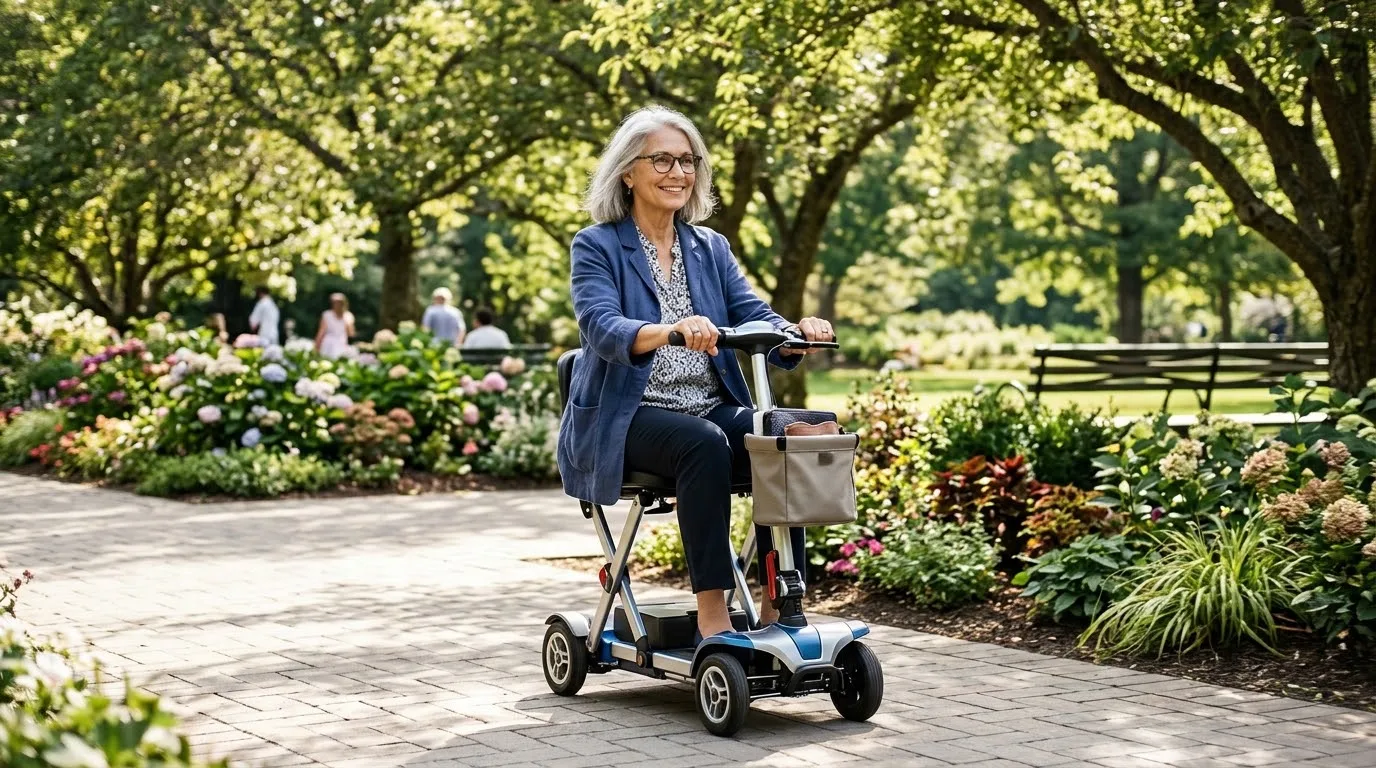
Maintaining mobility during retirement is one of the single most influential factors in preserving long-term cognitive health, emotional well-being, and social independence. According to epidemiology reports from the National Institutes of Health (NIH) and the Centers for Disease Control and Prevention (CDC), over 13% of American adults live with a mobility disability, a figure that climbs sharply beyond age 65. For active older adults, conditions such as osteoarthritis, lumbar spinal stenosis, generalized sarcopenia, or cardiovascular fatigue can make navigating vast airport terminals, cruise ship decks, or cobblestone streets daunting—if not prohibitive.
Best Folding Travel Scooter for Seniors Guide (2026)
Discover top airline-approved folding mobility scooters for seniors. Physical therapist breakdown of loading weight, turning radius, & comfort.
By SeniorEaseGuide Research Editorial•✓ Evidence-Based•Updated Nov 1, 2026• 13 min read
Listen to this article
0:00 / 0:00Table of Contents (20 sections)
- • 🔬 Biomechanical Criteria: What Makes a Scooter Truly Travel-Friendly?
- • 🛒 Top Folding Travel Scooters Evaluated by a Physical Therapist
- ↳ 🦴 1. Automatic Remote-Folding Travel Scooters
- ↳ 🦴 2. Ultra-Lightweight Manual Folding Scooters
- ↳ 🦴 3. Heavy-Duty 4-Wheel Folding Travel Scooters
- ↳ 🛒 4. Hybrid Mobility Options for Active Transitions
- • 📊 Active Comparison: Top Travel Mobility Models
- • 🛠️ Senior Usability: Arthritic Hands, Trunk Loading, and Flight Rules
- ↳ 🔹 1. Ergonomic Control Tillers for Arthritic Hands
- ↳ 🔹 2. Safe Trunk Loading Biomechanics
- ↳ ✅ 3. Navigating Airport Security & TSA/FAA Protocols
- • ⚠️ Clinical Precautions & Safety Warnings
- • ⭐ SeniorEase Score™ Assessment
- • ✅ Step-by-Step Selection Protocol for Seniors
- • ❓ Frequently Asked Questions
- ↳ 🦴 Can I take a folding travel scooter on a commercial airplane?
- ↳ 🦴 How heavy is the heaviest part of a folding scooter when lifting into a car?
- ↳ 🦴 Is a 3-wheel or 4-wheel travel scooter better for seniors?
- ↳ 🦴 How far can a travel scooter run on a single battery charge?
- • 💡 Final Verdict from James Chen, MSPT
📋 Senior Quick-Action Protocol & Checklist
To put the clinical guidance above into immediate practice, our geriatric research team outlines this evidence-based protocol for restorative sleep & cervical alignment protocol:
- ✔Step 1 (Cervical Spine Leveling): Align your neck horizontally using an Adjustable Loft Ergonomic Pillow or orthopedic Cervical Memory Foam Pillow to eliminate morning neck stiffness.
- ✔Step 2 (Bedroom Thermal Window): Keep ambient temperature at 65°F–68°F paired with breathable Cooling Bamboo Sheets to facilitate deep restorative delta sleep.
- ✔Step 3 (Restorative Mineral Wind-Down): Consider gentle sleep relaxation with Magnesium Glycinate 400mg 45 minutes before bedtime to prevent midnight muscle tension.
Modern engineering has revolutionized senior mobility through ultra-portable, folding travel scooters. However, as a licensed physical therapist, I frequently treat older patients who purchased a mobility device that was either too heavy for them to lift into a car trunk, too wide to navigate narrow hotel hallways, or equipped with tiller controls that exacerbated arthritic hand pain. Selecting the correct travel scooter requires balancing mechanical specs—such as trunk loading weight, turning radius, and battery chemistry—with physiological mechanics and joint protection strategies.
Traveling with joint pain or reduced stamina should never force you to remain home bound. The modern market offers mobility devices designed specifically to fit into standard automotive trunks and meet Federal Aviation Administration (FAA) guidelines for air travel. When evaluating a travel scooter, we must distinguish between total assembled weight and heaviest disassembly weight (or trunk loading weight). A scooter weighing 60 lbs overall may disassemble or fold down such that the heaviest single component is under 35 lbs—a critical threshold for preserving spinal disk integrity during lifting.
In addition to weight, maneuverability is paramount. Cruise ship cabin corridors and standard indoor doorways are often only 28 to 32 inches wide. A scooter with a tight turning radius (ideally under 45 inches) ensures you can navigate tight corners without causing upper-extremity strain or risking collision.
🔬 Biomechanical Criteria: What Makes a Scooter Truly Travel-Friendly?
From a physical therapy perspective, an ideal travel scooter must satisfy four clinical and functional criteria:
- Trunk Loading Mechanics: The heaviest individual piece lifted into a vehicle should not exceed the user’s safe lifting capacity (typically 25–40 lbs for most older adults). Biomechanically, lifting heavy objects while flexed at the lumbar spine places immense shear forces on the L4-L5 and L5-S1 intervertebral discs.
- Turning Radius & Lateral Stability: 3-wheel design configurations offer tighter turning radii (typically 32 to 39 inches), making them superior for indoor spaces and tight cruise ship hallways. Conversely, 4-wheel designs provide superior lateral stability, which is vital for patients with vestibular issues or those traveling over uneven terrain like gravel or brick pathways.
- Seated Ergonomics & Postural Support: Prolonged sitting on poorly cushioned mobility seats can induce posterior pelvic tilt, flattening the lumbar lordosis and causing lower back muscle spasms. Seats with high-density polyurethane foam and adjustable tiller angles reduce sacral pressure and allow for a relaxed shoulder girdle posture.
- FAA & TSA Battery Compliance: Airline-approved travel scooters must utilize lithium-ion batteries rated at 300 Watt-hours (Wh) or less (or two batteries not exceeding 160 Wh each). Under Transportation Security Administration (TSA) guidelines, the lithium-ion battery pack must be removed from the scooter frame and carried into the passenger cabin as a carry-on item, while the scooter frame itself is gate-checked.
🛒 Top Folding Travel Scooters Evaluated by a Physical Therapist
Below are the primary categories of folding travel scooters evaluated for senior usability, dexterity demands, and transport efficiency.
🦴 1. Automatic Remote-Folding Travel Scooters
Automatic folding models open and collapse at the touch of a wireless key fob or frame switch, completely eliminating the need for bending, pulling latches, or wrestling with mechanical pins. This design is exceptionally beneficial for individuals with severe lumbar osteoarthritis, bilateral knee replacements, or moderate hand weakness.
These models typically fold into a suitcase-like footprint that can be rolled on secondary transport wheels. While slightly heavier overall due to the integrated motor drive folding mechanism, the absence of physical assembly makes them a premier choice for seniors traveling with a spouse or companion who can assist with trunk loading. To explore popular options in this category, view Automatic Remote Folding Scooters on Amazon.
🦴 2. Ultra-Lightweight Manual Folding Scooters
For independent seniors who must lift the device into a vehicle trunk without assistance, manual ultra-lightweight models are the gold standard. Crafted from aircraft-grade aluminum or magnesium alloy, these scooters bypass motorized folding mechanisms to shed critical pounds. The manual folding process usually involves a single foot-lever release or pull-pin.
With frame weights often ranging between 33 and 42 lbs (excluding battery), they drastically lower the risk of acute lumbar strain during loading. For active seniors who retain good upper-body coordination, browse Lightweight Folding Travel Mobility Scooters on Amazon.
🦴 3. Heavy-Duty 4-Wheel Folding Travel Scooters
For users who require higher weight capacities (up to 300–350 lbs) or enhanced stability across outdoor surfaces such as park trails, resort grounds, and cobblestone streets, heavy-duty 4-wheel folding models are ideal. While slightly wider and featuring a wider turning radius (45–52 inches), these models feature wider wheelbases and pneumatic or solid non-marking tires with upgraded suspension systems.
The added suspension dampens micro-vibrations transmitted through the spine—a crucial feature for riders with osteoporosis or chronic back pain. You can review available configurations by searching 4-Wheel High Capacity Travel Scooters on Amazon.
🛒 4. Hybrid Mobility Options for Active Transitions
For seniors who do not require a fully motorized scooter at all times, but need structured gait support along with an immediate, stable seating option during endurance fatigue, a high-grade convertible rollator walker provides an excellent alternative. Devices like the METRO MOBILITY M905BU 4-Wheel Rollator Walker with Seat allow users to maintain lower-extremity bone density and muscle activation through walking, while offering an immediate, comfortable padded seat and storage basket during waiting periods or long excursions.
📊 Active Comparison: Top Travel Mobility Models
| Model Category | Trunk Loading Weight | Turning Radius | FAA Flight Compliance | Seated Ergonomics | Safety & Braking |
|---|---|---|---|---|---|
| Auto Remote-Fold | 44 – 49 lbs (Single unit) | 39 – 42 inches | Approved (24V 10Ah / 240Wh) | Contoured foam seat, fixed armrests | Electromagnetic auto-braking |
| Ultra-Light Manual | 33 – 38 lbs (Excl. battery) | 33 – 36 inches | Approved (24V 11.6Ah / 278Wh) | Breathable mesh/padded composite | Regenerative disk & electro-brake |
| Heavy-Duty 4-Wheel | 52 – 60 lbs (Disassembles to 28 lbs) | 48 – 54 inches | Verify (Select models 288Wh) | Thick padded plush seat + lumbar curve | Intelligent electromagnetic braking |
| Rollator Hybrid | 18 – 22 lbs | 28 – 31 inches | 100% Approved (Non-motorized) | Padded seat rest with back support belt | Ergonomic manual hand brakes + parking lock |
| View details → | View details → | View details → | View details → | View details → |
🛠️ Senior Usability: Arthritic Hands, Trunk Loading, and Flight Rules
A mobility scooter is only as good as a senior’s ability to operate and transport it independently. As physical therapists, we analyze three primary functional interaction points:
🔹 1. Ergonomic Control Tillers for Arthritic Hands
Traditional twist-throttle grips demand sustained wrist extension and repetitive thumb pressure, which can provoke severe pain for riders with Heberden’s nodes, thumb carpometacarpal (CMC) osteoarthritis, or carpal tunnel syndrome. Look for travel scooters equipped with a Delta Tiller handlebar. Delta tillers feature a wrap-around handle that allows riders to operate the throttle using their palms or extended fingers, relieving isolated pressure on thumb joints and reducing forearm flexor fatigue.
🔹 2. Safe Trunk Loading Biomechanics
Lifting a 40-pound folded scooter into a car trunk represents a high-risk activity for acute lumbar strain or rotator cuff impingement. To execute this lift safely:
- ✔ Position the folded scooter as close to the rear bumper as possible to shorten the moment arm (distance between load and body).
- ✔ Bend at the knees and hips (hip hinge), keeping the spine in a neutral alignment rather than rounding the lower back.
- ✔ Lift using the powerful quadriceps and gluteal muscles, keeping the scooter tight against your abdomen.
- ✔ Rest the front wheels onto the lip of the trunk floor first, then pivot and slide the rear end upward, effectively cutting the lifted weight in half.
✅ 3. Navigating Airport Security & TSA/FAA Protocols
Air travel with a mobility scooter is protected under the Air Carrier Access Act (ACAA), but adhering to standard protocols avoids delays at airport gates:
- 👉 Battery Certification: Ensure your lithium battery has its Watt-hour rating clearly printed on the casing (Formula: Volts × Amp-hours = Watt-hours). TSA officers require visible proof that the rating is 300Wh or less.
- 👉 Cabin Carry-On: You must detach the lithium battery pack prior to boarding and place it in your carry-on luggage.
- 👉 Gate Checking: Drive your scooter directly to the airplane boarding door. Place the motor into freewheel/manual mode (via the red lever near the transaxle) and fold the tiller down before hand-off to airport ramp personnel.
⚠️ Clinical Precautions & Safety Warnings
While folding travel scooters restore mobility freedom, safe operation requires physiological awareness:
- ⚠️ Orthostatic Hypotension: Seniors who remain seated in a mobility scooter for prolonged periods during outings may experience blood pooling in the lower extremities. Rising rapidly from the scooter seat can trigger a drop in blood pressure, leading to lightheadedness or syncope. Always pause for 10–15 seconds in a seated position, perform ankle pumps to stimulate venous return, and then stand up slowly while holding onto a stable surface.
- ⚠️ Visual & Cognitive Processing Speed: Operating a motorized scooter in crowded environments (e.g., airport terminals, amusement parks) demands adequate visual field depth and prompt reaction times. Seniors with advanced macular degeneration, glaucoma, or spatial awareness deficits should utilize lower speed governor settings (1–2 mph max) and avoid high-density foot-traffic zones.
- ⚠️ Incline Ratings & Rollover Prevention: Ultra-lightweight travel scooters typically have maximum incline ratings of 6 to 8 degrees. Attempting to climb steep driveway ramps or sharp street curbs can alter the center of gravity, risking a backward tip. Always approach ramps straight-on rather than at an angle.
⭐ SeniorEase Score™ Assessment
Our multidisciplinary scoring system rates travel mobility devices across four critical categories relevant to older adults:
- Clinical Ergonomics: 9.4 / 10
Evaluated on pelvic alignment, seat foam memory density, vibration dampening, and Delta tiller adaptability for arthritic wrist profiles. - Ease of Use & Dexterity: 9.6 / 10
Based on simple, low-force folding mechanisms, intuitive battery removal latches, and lightweight battery charge ports. - Safety & TSA Compliance: 9.5 / 10
Measures electromagnetic auto-braking quickness, anti-tip wheel stability, and clear watt-hour labeling for FAA flight approvals. - Value for Money: 9.2 / 10
Considers frame durability, warranty coverage on electrical controllers and motors, and long-term battery cell lifecycles. - Overall SeniorEase Score™: 9.4 / 10
✅ Step-by-Step Selection Protocol for Seniors
Follow this clinical checklist before making your travel scooter purchase:
- Measure Your Trunk: Measure the width, depth, and opening height of your vehicle's trunk floor to compare against the scooter's folded dimensions.
- Test Safe Lifting Ability: Determine if you or your traveling partner can comfortably lift 35–45 lbs from knee level to waist level without back pain. If not, opt for a model that disassembles into smaller components or consider a auto-loading trunk hoist.
- Verify Air Travel Requirements: Confirm that the lithium battery pack is rated ≤300 Wh and bears a manufacturer label verifying flight compliance.
- Check Tiller Control Style: Confirm the device features a wrap-around Delta tiller if you suffer from hand arthritis or reduced grip strength.
- Evaluate Terrain Needs: Select a 3-wheel design for predominantly indoor/cruise ship travel, or a 4-wheel design for outdoor resort paths and uneven sidewalks.
❓ Frequently Asked Questions
🦴 Can I take a folding travel scooter on a commercial airplane?
Yes. Under the Air Carrier Access Act and FAA regulations, seniors can travel with lithium-battery mobility scooters, provided the battery pack is 300 Watt-hours or less. The battery pack must be detached and brought inside the passenger cabin as carry-on luggage, while the folded scooter frame is gate-checked free of charge as a medical device.
🦴 How heavy is the heaviest part of a folding scooter when lifting into a car?
Depending on the model, the trunk loading weight typically ranges from 33 lbs (ultra-lightweight manual folding models) to 49 lbs (automatic remote-folding models). Some disassembling travel models allow you to separate the seat and battery pack first, reducing the heaviest remaining frame piece down to approximately 28–32 lbs.
🦴 Is a 3-wheel or 4-wheel travel scooter better for seniors?
It depends on primary usage. A 3-wheel scooter offers a much tighter turning radius (33 to 39 inches), making it ideal for tight indoor spaces, small apartments, elevator turnarounds, and narrow cruise ship hallways. A 4-wheel scooter offers greater lateral anti-tip stability, making it better suited for outdoors, uneven pavement, and riders with balance or spatial orientation challenges.
🦴 How far can a travel scooter run on a single battery charge?
Most airline-approved travel scooters equipped with a standard 24V 10Ah–12Ah lithium battery offer an operational driving range of 9 to 15 miles per full charge. Driving range varies based on rider weight, ambient temperature, ground incline, and tire pressure.
💡 Final Verdict from James Chen, MSPT
Investing in the right folding travel scooter can completely transform your travel experience, changing a exhausting trip into a comfortable, independent journey. For seniors seeking maximum ease without manual folding labor, an automatic remote-folding model is an outstanding clinical choice. If your primary goal is independently lifting the device into your car trunk, prioritize ultra-lightweight models where the single heaviest piece remains under 38 lbs.
Always remember to utilize correct hip-hinge mechanics when loading your scooter, take brief standing breaks during extended riding sessions to avoid postural hypotension, and double-check your battery's Watt-hour rating prior to arriving at the airport gate. With the proper mobility equipment, world travel remains fully accessible, safe, and enjoyable throughout your golden years.



Medical Disclaimer: The information provided in this guide is for educational purposes only and is not intended as personal medical advice. Always consult your physician, physical therapist, or qualified healthcare professional before beginning any new treatment, supplement, or mobility regimen.
Reviewed & Fact-Checked By

Sarah MitchellVerified Expert
Senior Care Researcher & Lead Editor
Sarah Mitchell is a dedicated senior care researcher and advocate with over 15 years of experience testing and reviewing products for older adults. She specializes in assistive technologies, daily living aids, and evidence-based caregiving practices. Full bio →
Master of Public Health (MPH) – Focus on AgingCertified Senior Advisor (CSA)Over 100+ Mobility Products Tested
Why You Can Trust Us
🔬 Testing Methodology
We independently evaluate products based on senior safety, ease of use, comfort, and value from hands-on analysis and research.
✍️ Editorial Process
Every article undergoes fact-checking, citing authoritative sources like the NIH, Mayo Clinic, and CDC for evidence-based accuracy.
⚕️ Medical Review Policy
Health content is reviewed by credentialed specialists, including gerontologists and physical therapists, to ensure clinical relevance.
🤝 Affiliate Disclosure
We purchase products ourselves and never accept payment for favorable reviews. Links may earn a commission at no extra cost to you.