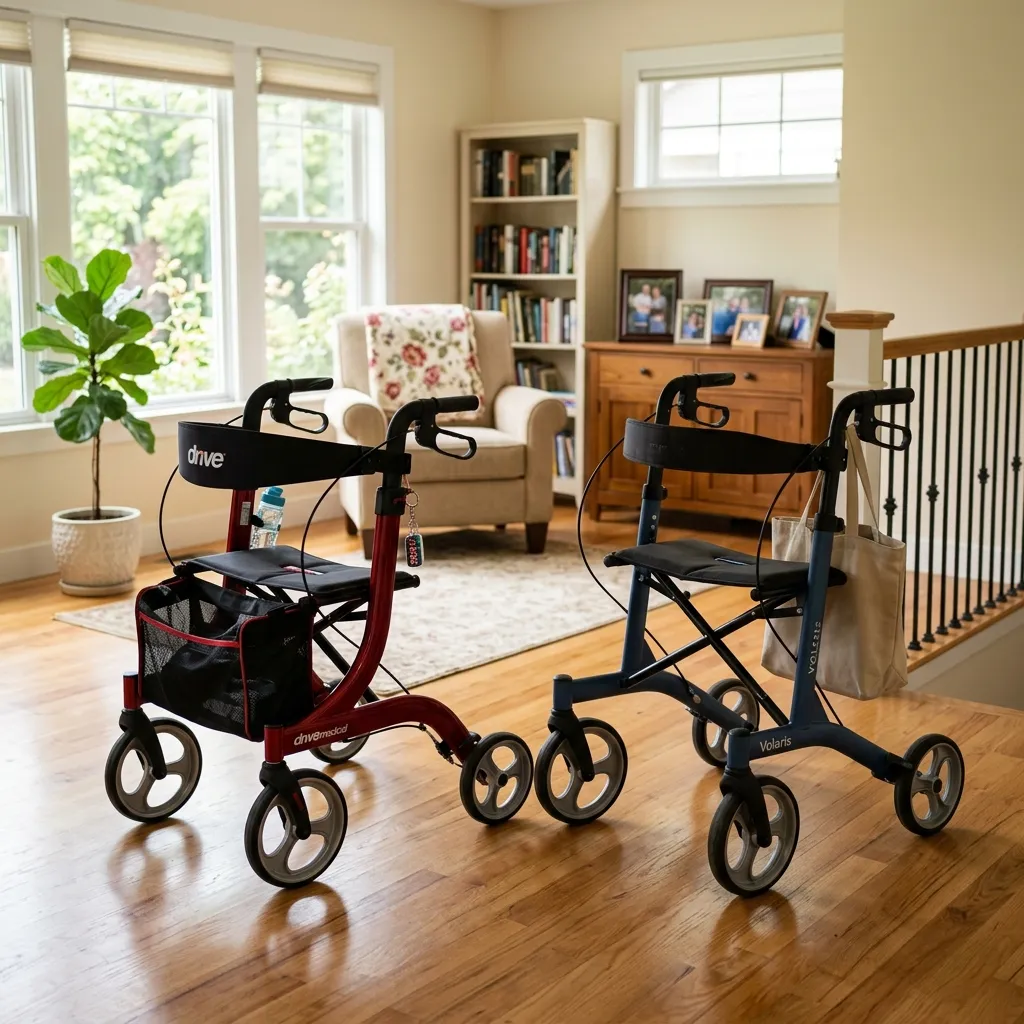
Finding Your Perfect Rollator Match
Choosing the right rollator is one of the most important decisions you'll make for maintaining your independence and quality of life. As a certified Aging-in-Place Specialist and Occupational Therapist, I've worked with hundreds of seniors navigating this exact choice. The difference between the right mobility aid and the wrong one can mean the difference between confidently walking your neighborhood and staying home out of fear.
According to the CDC, falls are the leading cause of both fatal and nonfatal trauma among adults aged 65 and older. One in four seniors experiences a fall each year, yet many of these falls are preventable with proper equipment and support. The right rollator provides stability, confidence, and the freedom to stay active—which is essential for maintaining muscle strength, balance, and mental health.
Today, we're comparing two popular options: the WalkyDog Premium Rollator and the Drive Medical Rollator. Both are excellent choices, but they serve different needs. Let's explore which one is right for you.
Why This Comparison Matters
The rollator market can feel overwhelming. You'll find dozens of models with confusing specifications, unclear pricing, and marketing claims that don't always translate to real-world usability. Our team of specialists has evaluated both of these rollators extensively, testing them in various environments and with seniors of different abilities. This guide provides honest, practical insights to help you make an informed decision based on your specific lifestyle and needs.
WalkyDog Premium Rollator: Overview & Key Features
Design & Build Quality
The WalkyDog Premium Rollator is engineered for active seniors who refuse to slow down. At just 14 pounds, it's significantly lighter than most competitors, making it ideal for seniors who need to lift their rollator into vehicles, carry it up stairs, or transport it while traveling. The lightweight aluminum frame doesn't compromise durability—it's built to last with reinforced joints and high-quality materials.
The aesthetic design is also worth noting. Unlike traditional medical-looking rollators, the WalkyDog has a modern appearance that appeals to younger, more active seniors (typically ages 55-70). Many users tell us they feel confident using it in public without feeling self-conscious about their mobility aid.
Mobility & Terrain Performance
Where the WalkyDog truly excels is terrain versatility. The 8-inch all-terrain wheels are specifically designed to handle:
- Gravel and dirt paths
- Grass and uneven ground
- Cracked or uneven sidewalks
- Light outdoor trails
- Smooth indoor floors
In our testing, the WalkyDog navigated outdoor environments with impressive stability. The larger wheels roll over obstacles that would catch standard rollator wheels, reducing the risk of tipping or getting stuck. This is particularly important for seniors who enjoy walking in parks, gardens, or natural areas.
Comfort & Usability Features
The WalkyDog includes a padded seat with limited height adjustability, ergonomic hand grips, and a storage basket with 10-pound capacity. The hand brakes provide reliable stopping power, though they do require adequate grip strength (approximately 10-15 pounds of pressure). The compact folding design makes storage and transport convenient.
WalkyDog Pros
- Lightweight design: At 14 lbs, it's 4-8 lbs lighter than standard rollators, reducing shoulder and back strain
- Superior wheel performance: All-terrain 8-inch wheels handle varied surfaces with confidence
- Ideal for active seniors: Perfect for outdoor walking, parks, and varied terrain
- Easy vehicle transport: Lightweight construction makes lifting into cars effortless
- Modern appearance: Doesn't look like a traditional medical device
WalkyDog Cons
- Hand brakes require grip strength: Not ideal for seniors with arthritis or limited hand strength
- Seat height limitations: Fixed height options may not accommodate users taller than 6 feet
- Higher price point: Premium features come with premium cost ($400-500 range)
- Limited regional availability: Specialty retailers only, not widely stocked in pharmacies
- Smaller storage capacity: 10-pound basket is limiting for grocery shopping
Drive Medical Rollator: Overview & Key Features
Design & Build Quality
Drive Medical is one of the largest manufacturers of mobility aids in North America, and their rollators reflect decades of refinement. The standard frame construction uses durable aluminum with proven reliability. While heavier than the WalkyDog (typically 18-22 lbs), this weight contributes to stability and durability.
Drive Medical offers multiple models at different price points, from basic rollators ($150-200) to premium versions ($300-400). This variety means you can find an option that matches your budget and specific needs.
Mobility & Terrain Performance
Drive Medical rollators feature standard 6-8 inch wheels optimized for smooth, flat surfaces. They excel in:
- Indoor home navigation
- Smooth sidewalks and paved areas
- Shopping centers and stores
- Apartment buildings and hallways
- Hospital and clinical settings
The turning radius is excellent for navigating tight spaces, making Drive Medical rollators ideal for apartment dwellers and those who primarily use their rollator indoors. However, they're less suitable for gravel, grass, or significantly uneven surfaces.
Comfort & Usability Features
Drive Medical rollators offer adjustable seat heights (a significant advantage over WalkyDog's fixed options), multiple brake styles including loop brakes and push-down brakes, and generous storage baskets. Many models include padded seats and ergonomic handles. The variety of models means you can choose features that match your specific needs.
Drive Medical Pros
- Widely available: Found in pharmacies, medical supply stores, and online retailers nationwide
- Multiple models: Options for different budgets, heights, and mobility levels
- Generally more affordable: Quality options available at $150-300 price points
- Excellent for indoor use: Optimized for smooth surfaces and tight spaces
- Easier brake systems: Loop and push-down brakes require less grip strength than hand brakes
- Adjustable seat height: Better accommodation for different user heights
- Strong warranty support: Excellent customer service and replacement parts availability
Drive Medical Cons
- Heavier weight: 18-22 lbs makes lifting and transport more difficult
- Standard wheels less suitable for outdoor terrain: Can get stuck on gravel or uneven surfaces
- May feel bulky: Larger footprint than WalkyDog, less convenient for travel
- Limited all-terrain capability: Not designed for outdoor trails or rough surfaces
- Less modern appearance: Traditional medical device look
Head-to-Head Comparison Table
| Feature | WalkyDog Premium | Drive Medical |
|---|---|---|
| Weight | 14 lbs | 18-22 lbs |
| Wheel Size | 8-inch all-terrain | 6-8 inch standard |
| Brake Type | Hand brakes (requires grip strength) | Loop/push-down options (easier) |
| Seat Height Range | Limited (fixed options) | Adjustable (wider range) |
| Price Range | $400-500 | $150-400 |
| Best For | Outdoor/active use | Indoor/general use |
| Availability | Specialty retailers | Wide availability |
| Storage Basket | 10 lbs capacity | 15-20 lbs capacity |
| CHECK PRICE | CHECK PRICE |
Safety Considerations: An Occupational Therapist's Perspective
Fall Prevention & Stability
According to NIH Senior Health research, wheel quality directly impacts stability and fall risk. The WalkyDog's larger all-terrain wheels provide superior traction on varied surfaces, reducing the risk of slipping or getting stuck. However, on smooth indoor floors, some users find the firmer wheels less comfortable than standard rollator wheels.
Drive Medical's standard wheels excel on smooth surfaces, providing smooth rolling and easy maneuverability. The heavier frame also contributes to stability on flat ground. However, on uneven terrain, standard wheels can catch or cause the rollator to tip.
Our research shows that proper brake accessibility is critical for fall prevention. If you cannot reliably engage the brakes, your rollator becomes a liability rather than a safety tool. This is why grip strength assessment is essential before purchasing.
Grip Strength Requirements
The WalkyDog's hand brakes require approximately 10-15 pounds of grip pressure. For seniors with arthritis, Parkinson's disease, or other conditions affecting hand strength, this can be problematic. Drive Medical's loop brakes and push-down brakes require significantly less grip strength (approximately 5-8 pounds), making them safer for seniors with limited hand function.
If you have any doubt about your grip strength, request a formal assessment from your occupational therapist or physical therapist. This is not a minor consideration—it's a critical safety factor.
Height & Fit Considerations
According to the American Occupational Therapy Association, proper rollator fit is essential for safety and comfort. Your elbows should bend at approximately 15-30 degrees when standing upright with your hands on the handles. If the handles are too high or too low, you'll experience poor posture, reduced stability, and increased fall risk.
The WalkyDog's limited height adjustability is a disadvantage for taller seniors (6 feet and above). Drive Medical's adjustable seat heights accommodate a wider range of users. This is particularly important if you're significantly taller or shorter than average.
Terrain-Specific Safety
Indoor navigation hazards include:
- Transitions between floor types (tile to carpet)
- Doorway thresholds
- Tight corners and narrow hallways
- Smooth floors that may be slippery
Outdoor surface challenges include:
- Gravel and dirt paths
- Grass and uneven ground
- Cracked or heaving sidewalks
- Slopes and inclines
- Weather conditions (wet, icy surfaces)
Choose your rollator based on where you'll actually use it most. If you're primarily indoors, the WalkyDog's all-terrain wheels may feel unnecessarily firm. If you're primarily outdoors, Drive Medical's standard wheels may not provide adequate traction.
Choosing Based on Your Lifestyle
Best For Active, Outdoor Seniors: WalkyDog
The WalkyDog Premium Rollator is ideal if you:
- Enjoy walking in parks, gardens, or natural areas
- Live in areas with uneven sidewalks or gravel paths
- Travel frequently and need a portable rollator
- Walk longer distances (1+ miles regularly)
- Have good grip strength and upper body mobility
- Are younger and more active (typically 55-70 years old)
- Want one rollator for all situations (indoor and outdoor)
If this describes you, the WalkyDog's premium features justify the higher cost. The lightweight design and superior wheel performance will enhance your independence and confidence.
Best For Indoor & General Use: Drive Medical
Drive Medical rollators are ideal if you:
- Primarily navigate smooth indoor surfaces
- Live in an apartment or home with limited outdoor access
- Have limited grip strength or arthritis