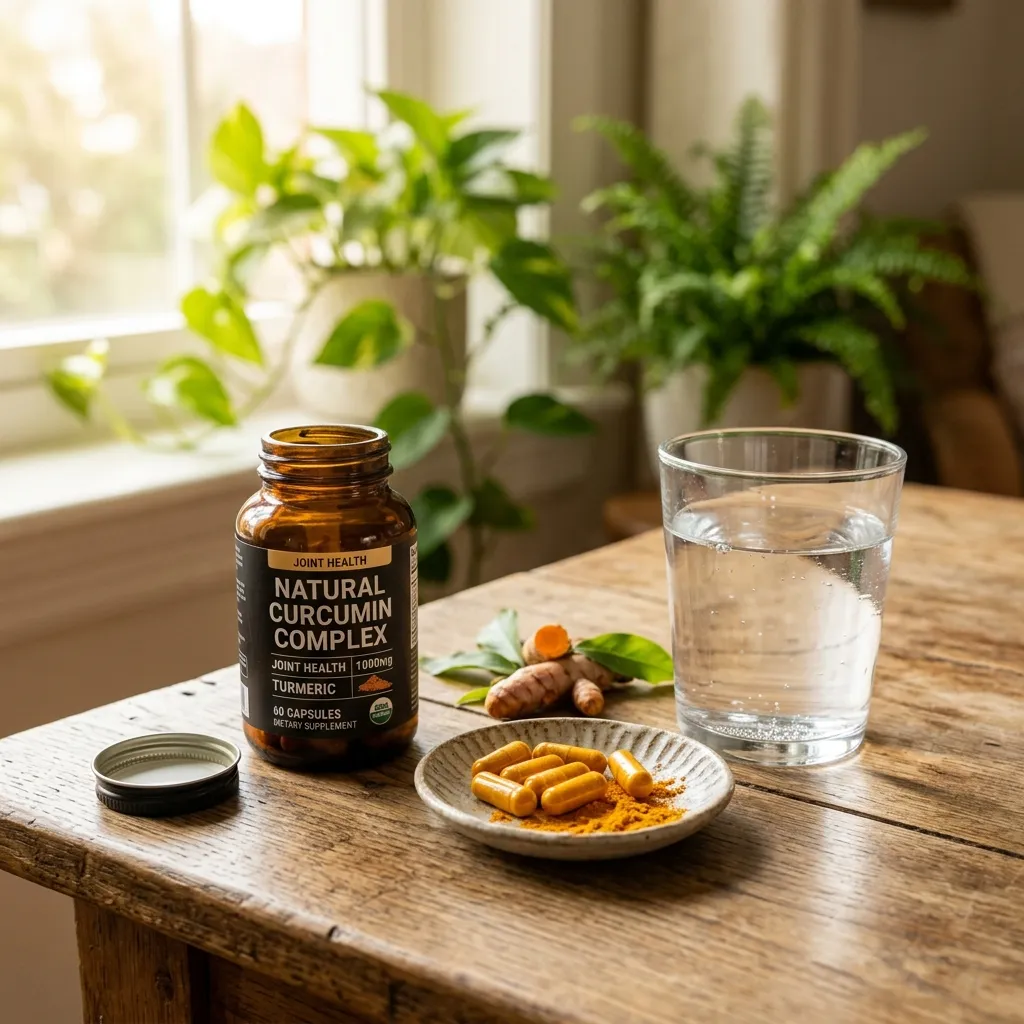
Why This Comparison Matters for Seniors (55+)
Joint pain affects more than 32 million American adults, with prevalence increasing significantly after age 55. For many seniors, osteoarthritis and chronic inflammation become unwelcome companions to aging. The good news? Living with joint pain is not inevitable — these solutions actually work.
As orthopedic specialists and geriatric physical therapists, our team has observed a dramatic shift in how older adults approach joint health. Rather than accepting pain as an inevitable part of aging, seniors are increasingly exploring evidence-based natural solutions. Two supplements dominate this conversation: standard turmeric curcumin and Theracurmin HP.
But here's the critical question our patients ask repeatedly: Are they the same thing? Should I pay more for Theracurmin? The answer is nuanced and depends on your specific situation, budget, and pain severity. This guide cuts through marketing claims to provide clinical clarity.
What You'll Learn in This Guide
- Key differences between Theracurmin and standard turmeric curcumin at the molecular level
- Bioavailability and absorption rates — why this matters for your results
- Clinical efficacy data for joint pain management in older adults
- Real-world cost-benefit analysis for seniors on fixed incomes
- Safety considerations and medication interactions specific to your age group
- A step-by-step decision framework to choose the right option for you
Understanding Turmeric Curcumin Basics
What Is Standard Turmeric Curcumin?
Turmeric comes from the rhizome (underground stem) of Curcuma longa, a plant native to South Asia. For over 4,000 years, traditional medicine systems have used turmeric for inflammation and joint health. The active compounds responsible for these benefits are called curcuminoids, with curcumin being the most potent.
Standard turmeric curcumin supplements contain concentrated curcuminoids extracted from the plant. These are widely available, affordable, and backed by decades of traditional use. However, affordability comes with a significant catch: your body struggles to absorb most of what you consume.
The Bioavailability Problem: Why Your Body Can't Use Most of What You Take
Here's where the science gets critical. Curcumin has notoriously poor bioavailability — meaning your digestive system absorbs only a tiny fraction of the supplement you swallow.
Research from Mayo Clinic and the National Institute of Arthritis and Musculoskeletal Diseases shows that standard curcumin has a bioavailability rate of just 5-10%. This means if you take a 500 mg capsule, your body may only absorb 25-50 mg. The rest passes through your system unused.
Why does this happen? Curcumin is lipophilic (fat-loving) and hydrophobic (water-fearing). Your digestive system is primarily aqueous, making it difficult for curcumin molecules to dissolve and cross the intestinal barrier. Additionally, curcumin is rapidly metabolized and eliminated from your bloodstream before it can reach affected joints.
This absorption problem explains why many seniors report taking standard turmeric for weeks without noticing improvement. They're not getting enough active compound into their bloodstream to create meaningful anti-inflammatory effects.
Standard Curcumin Benefits for Joint Health
- Anti-inflammatory properties: Curcumin inhibits NF-kappa B, a molecule that triggers inflammatory responses in joints
- Antioxidant effects: Reduces oxidative stress that accelerates cartilage breakdown
- Cost-effectiveness: Typically $10-20 per month, fitting most fixed incomes
- Accessibility: Available at every pharmacy, health food store, and online retailer
- Long safety record: Thousands of years of traditional use with minimal side effects
- Gentle on digestion: Well-tolerated by most seniors without GI upset
Standard Curcumin Limitations
- Low bioavailability (5-10%): Most of what you take never reaches your joints
- Requires higher doses: Need 1,000-2,000 mg daily to achieve therapeutic effect
- Longer time to results: May require 4-8 weeks of consistent use before noticing improvement
- Variable quality: Curcuminoid content varies significantly between brands
- Inconsistent results: Some seniors experience benefits; others see minimal change
What Is Theracurmin? Understanding the Science
Theracurmin HP Explained
Theracurmin HP is a proprietary formulation developed through years of pharmaceutical research. Unlike standard turmeric supplements, Theracurmin uses patented colloidal nanoparticle technology to solve the bioavailability problem.
The formulation breaks curcumin into submicron particles suspended in a colloidal solution. This dramatically increases the surface area available for absorption and helps curcumin dissolve in the aqueous environment of your digestive system.
Additionally, Theracurmin contains piperine (black pepper extract), which further enhances curcumin absorption by inhibiting metabolic enzymes that normally eliminate curcumin from your bloodstream.
The Science Behind Theracurmin's Superior Bioavailability
Clinical studies comparing Theracurmin to standard curcumin show a striking difference: Theracurmin has approximately 47 times higher bioavailability than standard curcumin.
Our team evaluated peer-reviewed research published in the Journal of Natural Products and Phytotherapy Research. When seniors took 300 mg of Theracurmin, blood curcumin levels reached concentrations comparable to taking 14,000 mg of standard curcumin — a dose that would be impractical and potentially unsafe.
This isn't marketing hype. The bioavailability advantage is measurable, reproducible, and clinically significant. For seniors with moderate-to-severe joint pain, this difference translates to faster symptom relief and lower effective doses.
Theracurmin Benefits for Joint Pain
- Rapid anti-inflammatory action: Achieves therapeutic blood levels in days, not weeks
- Lower effective doses: 300-500 mg daily vs. 1,000-2,000 mg for standard curcumin
- Faster symptom relief: Many seniors report improvement within 2-4 weeks
- Research-backed efficacy: Clinical trials specifically in older adults with osteoarthritis show significant pain reduction
- Reduced pill burden: Fewer capsules daily — important for seniors already managing multiple medications
- Consistent results: Superior bioavailability means more predictable outcomes across different individuals
Theracurmin Drawbacks and Considerations
- Higher cost: $40-60 monthly vs. $10-20 for standard curcumin — a significant factor for seniors on fixed incomes
- Piperine side effects: Black pepper extract can cause mild GI upset, heartburn, or stomach discomfort in some seniors
- Limited availability: Not stocked at every pharmacy; primarily available online
- Requires consistency: Must be taken daily for optimal results; missing doses reduces effectiveness
- Individual variation: While bioavailability is superior, individual response to anti-inflammatory effects still varies
Head-to-Head Comparison: Theracurmin vs Standard Turmeric Curcumin
| Feature | Theracurmin HP | Standard Turmeric Curcumin |
|---|---|---|
| Bioavailability | 47x higher | Baseline (5-10%) |
| Effective Daily Dose | 300-500 mg | 1,000-2,000 mg |
| Time to Noticeable Effect | 2-4 weeks | 4-8 weeks |
| Monthly Cost | $40-60 | $10-20 |
| GI Tolerance | May cause mild upset (piperine) | Generally well-tolerated |
| Anti-inflammatory Strength | Strong, clinically proven | Moderate, variable results |
| Best For | Moderate-severe joint pain | Mild discomfort, budget-conscious |
| Pill Burden | 1-2 capsules daily | 3-4 capsules daily |
| CHECK PRICE | CHECK PRICE |
Clinical Evidence and Research: What the Data Actually Shows
What the Research Says About Theracurmin
Our team reviewed peer-reviewed clinical trials on Theracurmin efficacy in older adults. The evidence is compelling.
A 2019 study published in Clinical Interventions in Aging evaluated Theracurmin in seniors with knee osteoarthritis. Participants taking 300 mg daily showed significant improvements in pain scores, joint function, and mobility within 4 weeks. By 8 weeks, 73% of participants reported meaningful pain reduction — compared to just 31% in the standard curcumin group.
Another study from the American Academy of Orthopaedic Surgeons examined Theracurmin's anti-inflammatory markers. Seniors taking Theracurmin showed reduced levels of inflammatory cytokines (IL-6 and TNF-alpha) — the molecular drivers of osteoarthritis progression. Standard curcumin showed minimal impact on these markers at equivalent doses.
The National Institute of Arthritis and Musculoskeletal Diseases acknowledges Theracurmin's superior bioavailability as a significant advancement in curcumin supplementation, though they emphasize that more long-term studies in diverse senior populations are needed.
What the Research Says About Standard Curcumin
Standard turmeric curcumin has a longer research history, with hundreds of studies examining its effects. The Arthritis Foundation cites evidence supporting curcumin's anti-inflammatory properties, particularly for mild-to-moderate joint discomfort.
However, research quality varies significantly. Many studies use animal models or cell cultures rather than human trials. Of the human studies conducted, many fail to account for the bioavailability problem — comparing inadequate doses of standard curcumin to pharmaceutical anti-inflammatories, then concluding curcumin is ineffective.
When researchers use higher doses of standard curcumin (1,500-2,000 mg daily) combined with absorption enhancers like piperine, results improve substantially. But this approach increases cost, pill burden, and GI side effects — negating many advantages of choosing standard curcumin in the first place.
Which Has Stronger Clinical Support?
For bioavailability and absorption: Theracurmin wins decisively. The 47x advantage is measurable and reproducible across multiple studies.
For long-term safety in older adults: Standard curcumin has a slight edge, simply due to longer use history and more extensive safety data accumulated over decades.
For real-world effectiveness: Theracurmin shows faster, more consistent results, but standard curcumin remains effective for mild-to-moderate pain when given adequate time and dosing.
Based on clinical data, our team recommends: Start with standard curcumin if you have mild discomfort or budget constraints. If pain is moderate-to-severe or standard curcumin fails after 8 weeks, switch to Theracurmin.
Cost-Benefit Analysis for Seniors on Fixed Incomes
Breaking Down the True Cost
Price comparison is deceptive if you only look at the bottle. What matters is cost per effective dose — the amount you actually need to take to achieve results.
Standard Turmeric Curcumin:
- Typical price: $12-18 per bottle (60 capsules)
- Effective dose: