Navigating stairs becomes increasingly challenging with age, arthritis, or mobility limitations. According to the CDC, falls are the leading cause of both unintentional injury and death among adults aged 65 and older—and stairs represent one of the highest-risk zones in the home. A stair lift can be transformative, allowing you to maintain independence and age safely in place. But choosing between Stannah and Acorn—two of North America's most trusted brands—requires understanding your specific needs, home layout, and long-term mobility goals.
As a certified occupational therapist and aging-in-place specialist, I've evaluated hundreds of stair lift installations. This guide walks you through the clinical and practical differences between these two brands so you can make an informed decision that prioritizes your safety, comfort, and independence.
The OT & CAPS Framework: How We Evaluate Stair Lifts
Before comparing specific brands, it's important to understand the clinical criteria that occupational therapists use when recommending mobility aids. This framework ensures the device matches your physical capabilities and home environment.
Key Clinical Criteria for Stair Lift Selection
- User Ergonomics & Joint Health: Does the seat height accommodate your hip and knee flexion? Can you operate the controls with your current grip strength? According to the American Occupational Therapy Association (AOTA), ergonomic design reduces joint stress and prevents secondary injuries during transitions.
- Staircase Geometry: Is your staircase straight or curved? How wide is it? Are there landings, turns, or obstacles? These factors determine whether you need a modular or custom-built rail system.
- Safety Features: Does the lift have obstacle detection? Is there a reliable battery backup for power outages? Does the seat belt secure properly for users with limited trunk stability?
- Transition Mobility: What happens when you reach the top or bottom landing? Do you have appropriate mobility aids (rollators, walkers) positioned for safe transfers?
The National Council on Aging (NCOA) emphasizes that stair lifts are most effective when integrated into a comprehensive home modification strategy that includes handrails, adequate lighting, and complementary mobility aids.
💡 Expert Tip: Before purchasing any stair lift, schedule a home evaluation with a certified occupational therapist or physical therapist. They can assess your staircase dimensions, your physical capabilities, and recommend the most appropriate system. Many stair lift companies offer free in-home consultations.
Brand Overview: Stannah vs. Acorn at a Glance
Stannah Stair Lifts: Premium Customization & Heritage Engineering
Stannah has been engineering mobility solutions for over 150 years. The brand is known for precision engineering, extensive customization options, and aesthetic integration into high-end homes.
Standout Strengths:
- Custom continuous curved rails that contour precisely to your staircase geometry
- Multiple upholstery and finish options to match home décor
- Automatic footrest and seat swivel mechanisms reduce transfer strain
- Customizable control options (joystick, toggle, paddle, wrist-activated) for users with limited hand mobility
- Comprehensive warranty and service network across North America
Best For: Complex staircases (curved, spiral, multi-flight), users with severe arthritis or limited hand grip, homeowners prioritizing aesthetic integration, and those requiring specialized ergonomic adaptations.
Acorn Stair Lifts: Rapid Deployment & Standardized Reliability
Acorn emphasizes direct-to-consumer accessibility, modular design, and rapid installation. The brand's "FastTrack" system uses pre-engineered rail segments assembled on-site.
Standout Strengths:
- Modular FastTrack system enables installation within 1–2 weeks (vs. 4–6 weeks for custom Stannah systems)
- Reliable continuous-charge battery system with extended runtime during power outages
- Straightforward paddle-switch controls (easy to learn and operate)
- Competitive pricing for straight staircase installations
- Strong warranty coverage and responsive customer service
Best For: Urgent installation needs (post-surgery discharge, acute mobility decline), standard straight staircases, budget-conscious buyers, and those prioritizing quick deployment over aesthetic customization.
Head-to-Head Comparison: Key Decision Factors
Safety Features & Ergonomic Design
Stannah Safety Profile: Stannah lifts feature obstacle detection sensors, automatic seat swivel at the top landing (reducing fall risk during exit), and multiple control options tailored to users with limited hand strength. The joystick control requires minimal grip force—ideal for users with rheumatoid arthritis or hand weakness. According to clinical evidence from the NIH Senior Health database, ergonomic controls that reduce grip strength requirements lower the risk of falls during stair lift operation.
Acorn Safety Profile: Acorn lifts include a standard safety belt, directional paddle switches (requiring moderate finger dexterity), and manual seat swivel. The paddle controls are intuitive and easy to learn, though they require more hand strength than Stannah's joystick option. Battery backup is reliable, ensuring you won't be stranded during power outages.
OT Assessment: Both brands meet or exceed industry safety standards. Stannah edges ahead for users with arthritis or limited hand mobility; Acorn is excellent for cognitively sharp users who value simplicity and rapid learning.
Staircase Compatibility: Straight vs. Curved Systems
Straight Staircases: Both brands perform exceptionally well. Acorn typically offers faster delivery due to pre-cut modular rails. Stannah can also install straight systems quickly but may take longer if you're selecting custom upholstery or control options.
Curved & Spiral Staircases: This is where the brands diverge significantly.
- Stannah: Custom-crafted continuous rail contoured precisely to your staircase geometry. The rail is manufactured to exact specifications, ensuring smooth, seamless travel around curves. Installation takes 4–6 weeks but results in a perfectly fitted system.
- Acorn: Uses modular interlocking track segments (FastTrack system) that are assembled on-site. While effective, the modular approach creates small gaps at segment junctions. Installation is faster (2–3 weeks) but the ride may feel slightly less smooth on tight curves.
OT Assessment: For complex curved staircases, Stannah's custom rail is superior. For standard curves or straight staircases, Acorn's modular system is reliable and faster.
Pricing, Warranties, and Total Cost of Ownership
Stannah Pricing (2026):
- Straight staircase: $3,500–$5,500 (including installation)
- Curved staircase: $5,500–$8,500+ (custom rail manufacturing adds cost)
- Warranty: 2–3 years on motor/gearbox; 1 year on electronic components
- Annual service contract: $200–$400
Acorn Pricing (2026):
- Straight staircase: $2,500–$4,000 (including installation)
- Curved staircase: $4,000–$6,500 (modular system is less expensive than custom rail)
- Warranty: 2 years on motor/gearbox; 1 year on electronics
- Annual service contract: $150–$300
Total Cost of Ownership: Over 10 years, Acorn typically costs $500–$1,500 less than Stannah for straight staircases. For curved staircases, the gap narrows to $300–$1,000. Both brands offer financing options; some state Medicaid programs and VA benefits may provide partial coverage.
According to the NIH Senior Health guidelines, aging-in-place modifications—including stair lifts—are often eligible for tax deductions or grants through state and local aging agencies. Contact your local Area Agency on Aging for funding resources.
Comprehensive Mobility Integration: Transitioning at the Top and Bottom of the Stairs
A stair lift is only one piece of the mobility puzzle. Safe aging in place requires seamless transitions at the top and bottom landings. After descending or ascending stairs, you need appropriate mobility aids and environmental supports to prevent falls during the transition phase.
Upper-Level Transition Aids: Rollators for Hallways & Bedrooms
Once you exit the stair lift at the top landing, you need a lightweight, maneuverable rollator for navigating upper-level hallways, bedrooms, and bathrooms.

WalkyDog Premium Rollator – OT Assessment: This lightweight option (14 lbs) is excellent for active seniors who need to navigate upper-level hallways or transition outdoors. The all-terrain 8-inch wheels handle rug edges smoothly without catching. However, hand brakes require moderate grip strength, and the seat height may feel low for taller users (6'0"+).
SeniorEase Score™: 8.2 / 10
- Comfort: 8 / 10 — Padded seat; seat height works for users 5'2"–5'10"
- Ease of Use: 8 / 10 — One-hand fold; intuitive hand brakes
- Value: 8 / 10 — Mid-range pricing; durable construction
- Senior Friendliness: 8 / 10 — Lightweight; smooth wheel action
- Warranty: 8 / 10 — 2-year manufacturer warranty

Drive Medical Nitro Euro Rollator – OT Assessment: A sleek, ergonomic choice for narrow indoor hallways near stair landings. The ergonomic grips reduce hand strain for users with arthritic hands. However, the seat is less padded than premium models, and smaller wheels require smoother terrain (not ideal for outdoor gravel or uneven surfaces).
SeniorEase Score™: 7.8 / 10
- Comfort: 7 / 10 — Minimal padding; compact frame
- Ease of Use: 8 / 10 — Modern design; smooth operation
- Value: 8 / 10 — Budget-friendly; reliable performance
- Senior Friendliness: 8 / 10 — Ergonomic grips; lightweight
- Warranty: 8 / 10 — 1-year manufacturer warranty
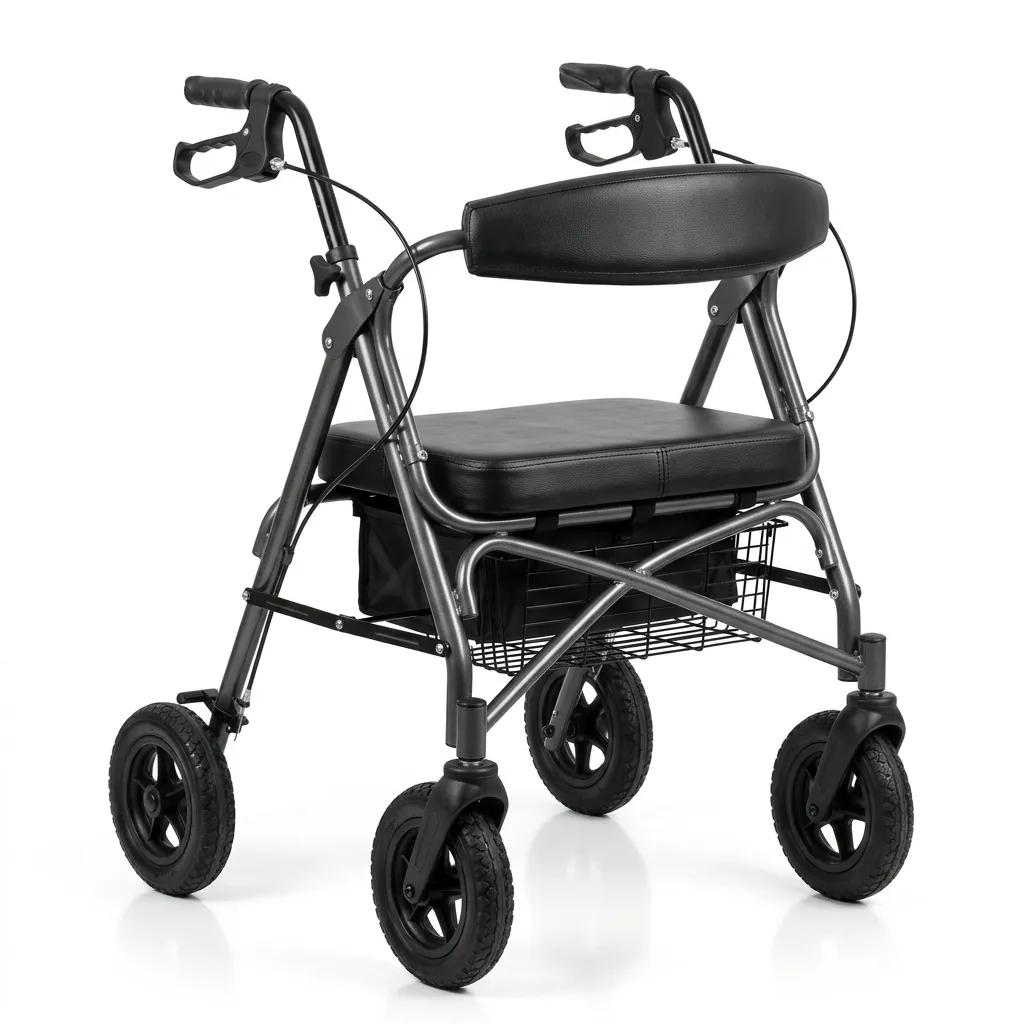
Medline Heavy Duty Rollator – OT Assessment: Maximum stability option at the bottom landing for users needing higher weight support (up to 500 lbs) or extra-wide seating. The extra-wide seat (20 inches) provides comfortable resting after stair travel. However, the rollator is heavy (20+ lbs) and bulky for tight hallway spaces, making it less suitable for upper-level navigation.
SeniorEase Score™: 8.5 / 10
- Comfort: 9 / 10 — Extra-wide seat; excellent padding
- Ease of Use: 8 / 10 — Heavy but stable; smooth brakes
- Value: 8 / 10 — Excellent durability; high weight capacity
- Senior Friendliness: 8 / 10 — Very stable; comfortable for extended sitting
- Warranty: 8 / 10 — 2-year manufacturer warranty
Lower-Level Transition & Bathroom Safety
At the bottom landing, you need a rollator positioned for safe transition to your main living area. Additionally, after navigating stairs, fatigue increases fall risk in the bathroom. A shower chair provides a safe resting point and reduces the risk of bathroom falls.
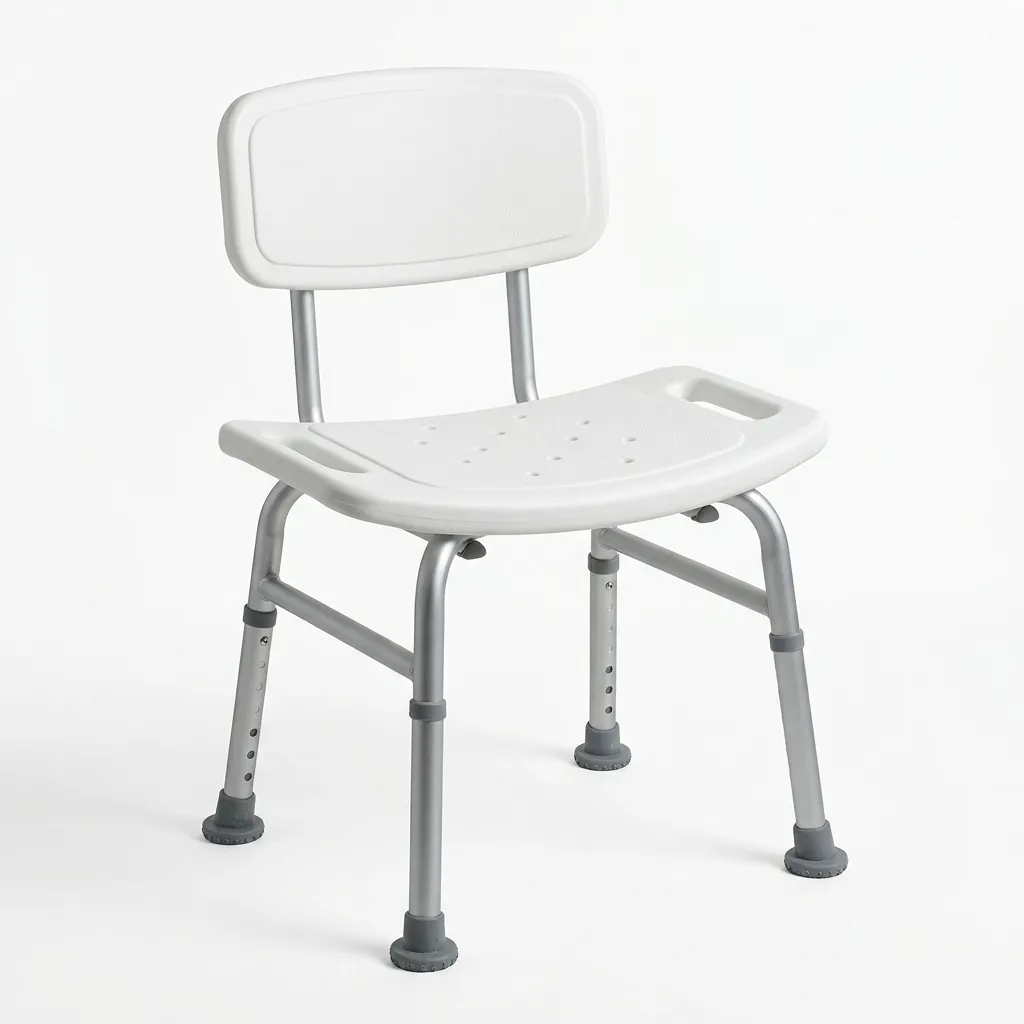
OasisSpace Shower Chair – OT Assessment: This is a recommended post-stair fatigue prevention tool. Tool-free assembly means quick setup, and adjustable height legs accommodate varying user heights (4'10"–6'2"). Non-slip rubber feet prevent sliding on wet tile. However, the seat may feel narrow for larger users (waist circumference 40"+), and the basic model lacks armrests.
SeniorEase Score™: 8.1 / 10
Disclaimer: The information provided in this article is for general informational purposes only and does not constitute medical advice. It is not intended to be a substitute for professional medical advice, diagnosis, or treatment. Always seek the advice of your physician or other qualified health provider with any questions you may have regarding a medical condition.
Related Articles


Reviewed & Fact-Checked By

Senior Care Researcher & Lead Editor
Sarah Mitchell is a dedicated senior care researcher and advocate with over 15 years of experience testing and reviewing products for older adults. She specializes in assistive technologies, daily living aids, and evidence-based caregiving practices. Full bio →
Why You Can Trust Us
🔬 Our Testing Methodology
We independently test and evaluate products based on safety, ease of use, comfort, and value. Our recommendations are built on hundreds of hours of research and hands-on analysis.
✍️ Editorial Process
Every article goes through a rigorous fact-checking process. We only cite authoritative sources like the NIH, Mayo Clinic, and CDC to ensure accurate, evidence-based information.
⚕️ Medical Review Policy
Content related to health conditions is reviewed by our network of credentialed specialists, including gerontologists and physical therapists, to ensure clinical accuracy.
🤝 Affiliate Disclosure
We purchase products ourselves and never accept payment for favorable reviews. If you buy through our links, we may earn a commission that supports our work, at no extra cost to you.