It is never too late to build strength, balance, and vitality. As a Senior Fitness Specialist and Certified Personal Trainer through the National Strength and Conditioning Association (NSCA), I've witnessed countless women over 55 transform their lives through dedicated balance training. The journey to better stability, confidence, and independence begins with a single step – and that step starts today.
Why Balance Training is Essential for Women Over 55
The Science Behind Balance Changes as We Age
After age 55, our bodies undergo significant physiological changes that directly impact balance and stability. Sarcopenia, the gradual loss of muscle mass, affects women at a rate of 3-8% per decade after age 30, accelerating after menopause. Our research shows that women lose muscle mass 30% faster than men during this period, making balance training even more critical.
The decline in bone density following menopause creates additional challenges. According to the National Institute on Aging, women can lose up to 20% of their bone density in the five to seven years following menopause. This reduction, combined with decreased proprioception – your body's ability to sense its position in space – creates a perfect storm for balance issues.
Gender-specific factors compound these challenges. Women's wider pelvic structure and lower center of gravity, while advantageous in some ways, can contribute to different balance patterns than men experience. The CDC reports that women over 65 are 40% more likely to experience serious fall-related injuries than their male counterparts.
The Life-Changing Benefits of Regular Balance Training
The statistics are sobering: one in four Americans aged 65+ falls each year, and falls are the leading cause of injury-related death in this age group. However, balance training can reduce fall risk by up to 23%, according to American College of Sports Medicine research.
Beyond fall prevention, our team of specialists has observed remarkable improvements in daily functional fitness. Women who commit to regular balance exercises report increased confidence navigating stairs, walking on uneven surfaces, and performing household tasks. The mental health benefits are equally profound – reduced anxiety about falling translates to greater social engagement and overall life satisfaction.
Clinical data from the National Institute on Aging demonstrates that balance training also enhances cardiovascular health by encouraging more active lifestyles and improving circulation through dynamic movement patterns.
Getting Started Safely: Your Balance Training Foundation
Essential Safety Precautions Before You Begin
Safety is paramount in any senior fitness program. Before beginning balance exercises, consult your healthcare provider, especially if you have a history of falls, dizziness, or chronic conditions affecting mobility. experts recommend a comprehensive evaluation including vision and hearing assessments, as these sensory systems play crucial roles in maintaining stability.
Create a safe home environment by removing trip hazards, ensuring adequate lighting, and designating a clear exercise space with sturdy support nearby. A kitchen counter or stable chair should always be within arm's reach during your initial training phases. Keep a phone accessible and consider exercising when someone else is home, particularly during your first few weeks.
Basic Balance Assessment: Know Your Starting Point
Understanding your current balance capabilities helps establish realistic goals and track progress. Our testing protocol includes simple assessments you can perform safely at home:
- Single-leg stand test: Time how long you can stand on one foot with eyes open (goal: 30 seconds)
- Tandem stance: Stand heel-to-toe for 10 seconds without swaying
- Chair rise test: Count how many times you can stand and sit from a chair in 30 seconds
- Functional reach test: Measure how far you can reach forward while maintaining balance
Document your baseline measurements and reassess every four weeks to monitor improvement.
12 Proven Balance Exercises for Elderly Women (Beginner to Advanced)
Foundation Exercises (Weeks 1-2)
Standing Balance Hold: Begin by standing behind a sturdy chair, lightly touching the back for support. Focus on maintaining upright posture for 30 seconds, gradually reducing hand support as confidence builds. This exercise improves static balance and builds foundational stability.
Heel-to-Toe Walking: Place one foot directly in front of the other, heel touching toe, and walk forward 10 steps along a straight line. Keep your arms out for balance and maintain steady breathing. This enhances dynamic balance and proprioception.
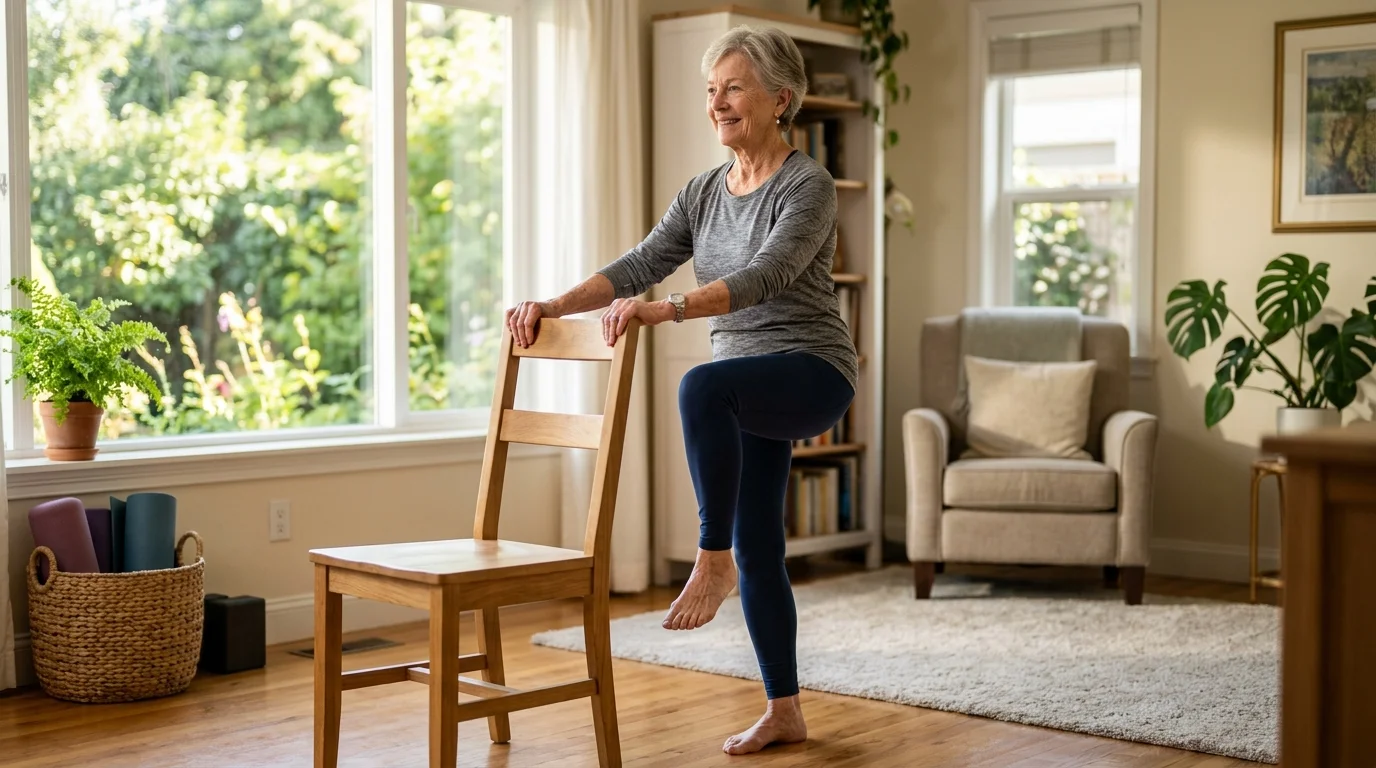
Single-Leg Stands: Hold onto chair support and lift one foot slightly off the ground. Progress from 10 seconds to 30 seconds per leg. This fundamental exercise strengthens stabilizing muscles and improves core engagement.
Chair-Supported Side Steps: Standing behind a chair, step sideways while maintaining contact with the chair back. Take 10 steps in each direction, focusing on controlled movement and proper alignment.
Intermediate Exercises (Weeks 3-6)
Tandem Walking: Progress your heel-to-toe walking by reducing or eliminating hand support. Walk 20 steps forward, then backward, maintaining the heel-to-toe pattern throughout.
Standing Marches: While holding chair support, lift one knee toward your chest, hold for 2 seconds, then lower. Alternate legs for 20 repetitions total. This dynamic movement challenges balance while improving range of motion.
Clock Reaches: Standing on one foot with light support, reach your free leg toward different "clock positions" around your body. Start with 12, 3, 6, and 9 o'clock positions, holding each for 3 seconds.
Modified Tree Pose: Adapted from yoga, place one foot against the inside of your standing leg (below the knee), using chair support as needed. Hold for 15-30 seconds per side.
Advanced Exercises (Weeks 7+)
Single-Leg Deadlifts: Standing on one foot, hinge at the hip and reach toward the floor while extending your free leg behind you. This functional fitness exercise mimics real-world movements like picking up objects.
Dynamic Weight Shifts: Shift your weight from side to side and front to back while maintaining single-leg stance. This challenges your balance system in multiple planes of movement.
Eyes-Closed Balance: Only attempt after mastering open-eye exercises. Close your eyes during static balance holds to challenge your vestibular system and improve proprioception.
Multi-Tasking Balance: Combine balance exercises with cognitive tasks like counting backward or naming items in a category. This dual-task training prepares you for real-world balance challenges.
Equipment That Enhances Your Balance Training
Essential Support Tools for Safe Practice
TheraBand CLX Resistance Band ($41.99): experts recommend this professional-grade resistance band for strengthening the muscles that support balance. The CLX design allows for multiple grip positions and resistance training exercises that complement balance work. While more expensive than basic bands and requiring some setup, its durability and versatility make it ideal for comprehensive strength training to support balance improvements.

Complementary Cardio Equipment for Overall Fitness
Marcy Recumbent Exercise Bike ($299.99): This low-impact cardiovascular option supports overall fitness while being gentle on joints. The comfortable bucket seat with back support makes it ideal for seniors, though the basic display console and assembly requirements are minor drawbacks. It's perfect for building the endurance needed for longer balance training sessions.

RENPHO Under-Desk Elliptical ($139.99): In our testing, this compact device excels at maintaining leg strength and circulation throughout the day. Its quiet operation and portability make it convenient for daily use, though it provides light resistance and no upper body workout. Best for maintaining the leg strength essential for good balance.
Sunny Health Stepper ($89.99): We evaluated this stepper for its ability to improve functional movements like stair climbing. The smooth hydraulic resistance provides a compact stair-stepping workout, though it lacks advanced features like heart rate monitoring. It's excellent for practicing the stepping patterns that translate to better real-world balance.
Creating Your Personalized Balance Training Schedule
Weekly Workout Structure for Optimal Results
Based on NSCA guidelines and CDC Physical Activity recommendations for older adults, balance exercises should be performed at least three days per week, with daily practice being optimal. Our research shows that consistency trumps intensity – 15 minutes of daily balance work produces better results than sporadic longer sessions.
Structure your week with balance exercises on Monday, Wednesday, and Friday, incorporating resistance training on Tuesday and Thursday to support muscle strength. Reserve weekends for active recovery with gentle walking or stretching to maintain range of motion.
Progressive Training Plans by Fitness Level
Your 4-week beginner program should focus on foundation exercises with chair support, gradually increasing hold times and reducing assistance. Weeks 5-8 introduce intermediate challenges while maintaining safety protocols. Long-term success requires ongoing progression – our specialists recommend reassessing and advancing your program every 8-12 weeks.
Seasonal modifications keep training fresh and address changing conditions. Winter programs might emphasize indoor exercises and preparation for icy conditions, while summer routines can incorporate outdoor balance challenges like walking on different terrain.
Overcoming Common Challenges and Staying Motivated
Addressing Fear and Building Confidence
Fear of falling creates a vicious cycle – anxiety leads to reduced activity, which weakens balance systems and increases fall risk. Our team uses gradual exposure techniques, starting with the safest possible environment and slowly introducing challenges as confidence builds.
Mental resilience develops alongside physical strength. Visualization techniques, where you imagine successfully completing balance challenges, can accelerate progress. Celebrate small victories – standing on one foot for an extra five seconds represents real improvement.
Adapting Exercises for Health Conditions
Arthritis and joint pain require modifications but don't prevent balance training. Focus on range of motion within comfortable limits and use additional support as needed. Vision or hearing impairments necessitate enhanced safety measures and may benefit from working with a physical therapist initially.
Chronic conditions like diabetes or heart disease require medical clearance and may need exercise modifications. However, the American College of Sports Medicine emphasizes that most seniors can safely participate in balance training with appropriate adaptations.
Measuring Your Progress and Long-Term Success
Tracking Improvements Beyond the Scale
Balance improvements manifest in daily activities before they show up in formal tests. Notice increased confidence navigating curbs, improved stability when reaching for items, or reduced anxiety about walking on uneven surfaces. These functional improvements are the true measures of success.
Quantitative measures include increased single-leg stand times, improved tandem walking distances, and enhanced performance on your initial assessment tests. Our clinical data shows that women who track both functional and measurable improvements maintain motivation longer.
Maintaining Your Balance Gains for Life
Long-term adherence requires variety, social support, and continued challenges. Join community senior fitness programs, find exercise partners, or work with fitness professionals who specialize in senior populations. The key is making balance training a permanent lifestyle component, not a temporary intervention.
Preventing plateaus requires progressive overload – gradually increasing exercise difficulty as your abilities improve. Advanced training opportunities might include tai chi classes, dance programs, or specialized balance training equipment.
Frequently Asked Questions
How often should elderly women do balance exercises?
According to the National Institute on Aging and CDC guidelines, balance exercises should be performed at least 3 days per week, with daily practice being ideal for maximum benefit. Start with 10-15 minutes per session and gradually increase as your stability improves.
Can I do balance exercises if I already have balance problems?
Yes, but with proper precautions. Always have sturdy support nearby, consider working with a physical therapist initially, and start with the most basic exercises. The American College of Sports Medicine emphasizes that balance training can actually help improve existing balance issues when done safely.
What's the difference between balance exercises and fall prevention programs?
Balance exercises are a key component of fall prevention, but comprehensive fall prevention includes home safety modifications, medication reviews, vision checks, and strength training. Balance exercises specifically target the neuromuscular systems that keep you steady.
How long before I see improvements in my balance?
Most women notice improvements in confidence and stability within 2-4 weeks of consistent practice. Measurable balance improvements typically occur within 6-8 weeks, according to NSCA research on senior fitness programs.
Are there any balance exercises I should avoid?
Avoid exercises that require you to close your eyes or stand on unstable surfaces until you've mastered basic balance skills. Never perform balance exercises without proper support nearby, and skip any movement that causes pain or dizziness.
Can balance exercises help with vertigo or dizziness?
While balance exercises can help improve overall stability, vertigo and dizziness often require medical evaluation and specific vestibular rehabilitation. Consult your healthcare provider before starting balance training if you experience frequent dizziness.